036. Gluck
On Their Own Terms: The Uncompromising Life of Gluck
Introduction
*A note on pronouns: Various records and articles referencing Gluck use female and gender neutral pronouns. As Gluck rejected traditional gender roles and titles, Pride Palette has decided the use of the singular “they” is most appropriate.
Gluck, the name inscribed on the back of every print with the firm instruction ‘no prefix, suffix, or quotes’, was a British painter whose life and work constitute one of the most radical acts of self-creation in twentieth-century art. Born into the enormously wealthy Gluckstein family in London in 1895, Gluck rejected the name, the gender conventions, and the social expectations that came with their privileged upbringing, forging instead a singular identity that defied every category society attempted to impose upon them. In an era when words like ‘transgender,’ ‘nonbinary,’ and ‘genderqueer’ did not yet exist in public conversation, Gluck lived their life in open, unapologetic refusal of the binary: cutting their hair short, dressing exclusively in men’s tailoring, and insisting on a single, ungendered moniker that defied categorization.
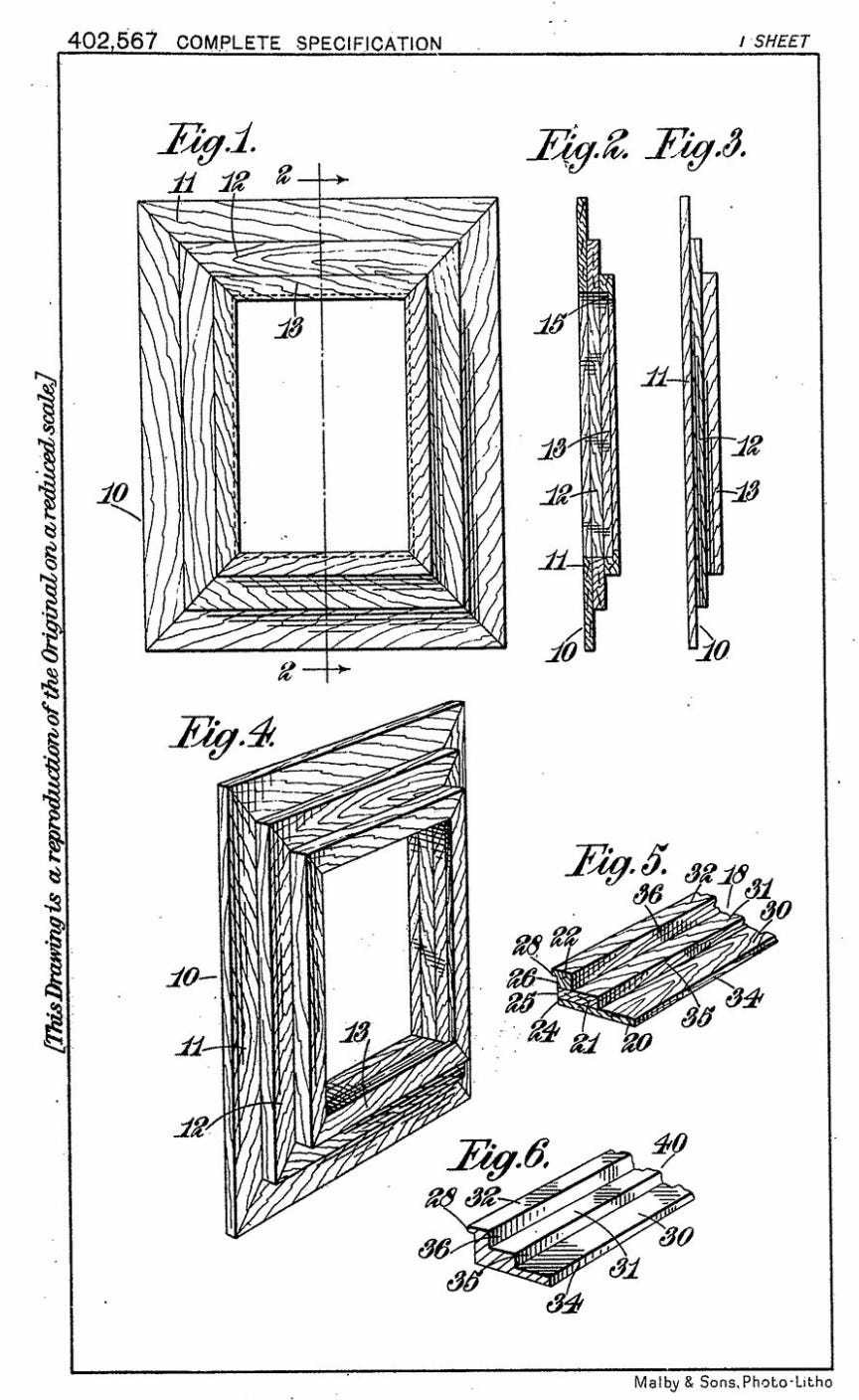
Gluck rose to considerable prominence during the 1920s and 1930s as a painter of exquisite portraits, lush floral compositions, and theatrical scenes, earning the admiration of critics, royalty, and the British artistic establishment alike. Yet their artistic identity was never separable from their personal one. Every element of how Gluck presented their work, from the revolutionary tiered ‘Gluck frame,’ the insistence on solo exhibitions only, to the meticulous control over how their name appeared on every document, was part of a cohesive, carefully constructed self that merged art and identity into a single, indissoluble statement. To encounter Gluck’s paintings was to encounter Gluck: autonomous, androgynous, and uncompromising.
The relationships Gluck formed, with the florist Constance Spry, with the socialite Nesta Obermer, and with journalist Edith Shackleton Heald, were not merely personal but artistic, each woman profoundly influencing the direction of Gluck’s work. Most famous among the paintings these relationships inspired is Medallion (1936), the dual self-portrait with Nesta Obermer that Gluck called the ‘YouWe’ picture, a bold, unprecedented declaration of same-sex love made at a time when male homosexuality was still a criminal offense and no acceptable public vocabulary existed for same-sex love. Medallion is today recognized as one of the most important works of queer art in British history.
Gluck died in 1978, having spent their final years in Sussex with Edith Shackleton Heald, and having made one last triumphant return to the exhibition room in 1973. In the decades since their death, Gluck’s reputation has grown steadily, their work and life claimed by queer historians, art scholars, and LGBTQIA2S+ communities as a forerunner of contemporary conversations about gender identity, artistic autonomy, and the relationship between selfhood and creative expression. Gluck is now recognized not merely as a significant modernist painter but as a trailblazer whose life was itself a work of art, radical, resilient, and endlessly resonant.

Early Life and Background
Cultural and Personal Influences
The family into which Gluck was born in 1895 was the domestic catering empire of J. Lyons & Co., whose Corner House tearooms were ubiquitous in British cities and whose influence extended from hotel chains to mass catering contracts. Gluck’s grandfather Samuel Gluckstein had co-founded Salmon & Gluckstein, the tobacco retailing giant, and the family fortune had since grown into something vast and complicated, administered through The Fund, a communal money pool that pooled resources across the extended Gluckstein clan. Joseph, Gluck’s father, was a senior figure in this empire. Their family was Orthodox Jewish, conservative, and deeply invested in respectability, social standing, and the proper performance of gender. For a child who would grow up to cut off all their hair, wear men’s suits, and insist on a genderless single name, this was a formative pressure, and a formative resistance.
Gluck’s mother, Francesca Halle, was American-born and artistically gifted, a trained opera singer who had moved to England and married Joseph Gluckstein just weeks after meeting him. Their marriage was marked by instability: Francesca suffered repeated episodes of what contemporaries called ‘nervous breakdowns,’ and spent time confined to a mental institution. The combination of a domineering, wealthy father, an emotionally fragile and artistically unfulfilled mother, and a family apparatus that expected daughters to marry well and sons to carry on the business, produced in Gluck a profound desire for escape. Painting became the vehicle for that escape. It was the one arena where Gluck could insist on total autonomy, where no family name or dynastic expectation could reach.
The Gluckstein family’s Jewishness was not merely a religious fact but a social one, a marker of a particular kind of British Jewish identity that had, by the late Victorian era, achieved wealth and respectability but remained conscious of its position as a minority identity within the English upper class. Gluck would later refuse any association with the Gluckstein family name in their professional life, insisting that their work be attributed only to ‘Gluck’, no further specification. This severance had multiple motivations, but one of them was surely the desire to exist as a self-made identity, independent of the social freight carried by a name that stood for commerce, Jewishness, and conservative propriety. In the twentieth century’s long conversation about identity, selfhood, and belonging, Gluck was an early and fiercely self-aware participant.
What the Gluckstein family background gave Gluck, paradoxically, was the material means to defy it. The Fund, administered by the family patriarch, provided a trust that would be available to Gluck at twenty-one, and their father later purchased Bolton House in West Hampstead as Gluck's London residence. This financial cushion, however ambivalently held, meant that Gluck could pursue an independent life as an artist without the full precarity that such a choice would have imposed on someone outside their class. It also gave Gluck access to the upper echelons of British social life, where their androgynous appearance and artistic reputation could become a kind of fashionable eccentricity rather than a social liability. The tension between this privilege and Gluck's refusal to be defined by family name or expectation shaped their entire public life.
The cultural context into which Gluck was born was simultaneously constrictive and, for those bold enough to navigate it, surprisingly permissive in certain circles. The early twentieth century saw a generation of gender-nonconforming women, many of them wealthy, educated, and connected, carving out spaces for themselves in London's bohemian artistic and literary communities. Figures like Radclyffe Hall, Vita Sackville-West, and Romaine Brooks occupied a similar liminal space: gender-neutral in dress and relationship, but often protected from the harshest social consequences by class and cultural cachet. Gluck moved in and among these worlds, and their Jewish identity added another layer of outsiderness that reinforced the sense of being constitutively outside convention, a position they came to occupy with pride and precision.
Early Exposure to Art and Education
Gluck’s earliest formal education took place at the Dame School in Swiss Cottage, which they attended until 1910, followed by St Paul’s Girls’ School in Hammersmith until 1913. It was at St Paul’s that their artistic talent first received institutional recognition: in 1913, Gluck was awarded a Royal Drawing Society silver star, a distinction that signaled that whatever else the Gluckstein family might have imagined for their eldest child, there was a genuine creative gift at work. Their mother’s background as a trained opera singer had given Gluck an early and deep relationship with the arts broadly, they inherited Francesca’s fine singing voice and for a time appeared destined for a musical career. It was a portrait of the musician Joseph Joachim by John Singer Sargent that redirected Gluck from music to painting: seeing what painting could do with a musician’s face convinced them that the visual arts were their true medium.
In 1913, Gluck enrolled at the St John’s Wood School of Art in London, studying there until 1916. These three years were transformative, not only artistically, but personally and socially. At St John’s Wood, Gluck encountered fellow students who were similarly unconventional, among them the gender-nonconforming student known simply as Craig (E. M. Craig, 1893–1968), who went by her surname alone and became Gluck’s close companion and likely first lover. The two would eventually flee London together for Cornwall. Craig’s influence on Gluck’s sense of self should not be underestimated: Nesta Obermer recalled decades later that Gluck loved to tell everyone about the story of ‘running away’ with Craig, retelling it to every new acquaintance and regarding it as the defining act of their early adult life. The running away was not merely geographical, it was an escape from family, from expectation, and from the gendered identity that both had been assigned at birth.
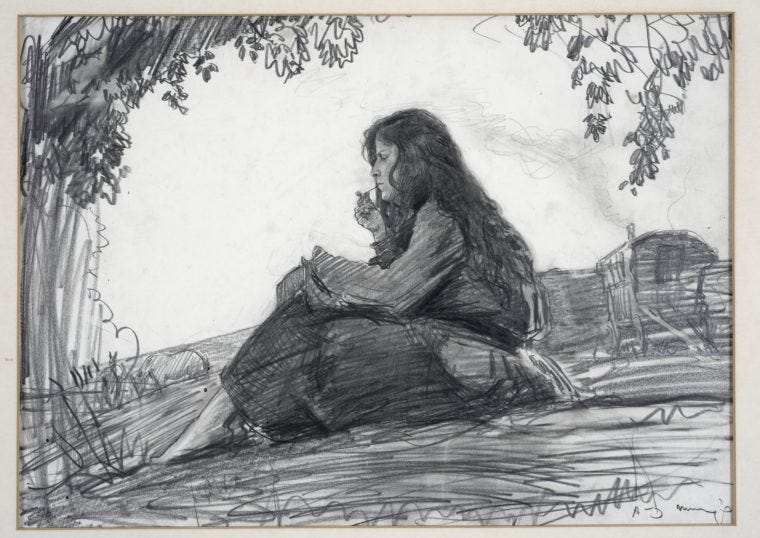
In 1916, Gluck left London for the Lamorna artists’ colony in southwest Cornwall, near Penzance, joining a community of painters associated with the Newlyn School. This bohemian enclave, devoted to plein air painting (painting outdoors), the extraordinary quality of Cornish light, and a relative freedom from metropolitan social convention, proved to be the crucible in which Gluck’s mature identity and artistic vision were formed. Among the painters at Lamorna were Alfred Munnings, Laura and Harold Knight, and Lamorna Birch, all known for realist pastoral scenes and portraiture. Munnings sketched Gluck in 1916 smoking a pipe/cigarette, a deliberately masculine image. The Newlyn painters’ influence is visible in Gluck’s early attention to light, their realistic handling of observed subjects, and a certain directness of gaze, both their own and that of their subjects.
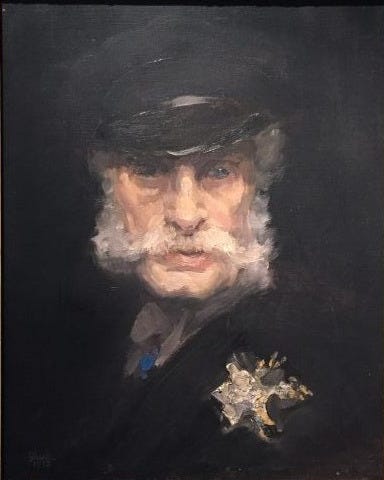
It was in Lamorna that Gluck painted their earliest known work, The Artist’s Grandfather (1915), reportedly completed in a single hour. The dark background and thick brushstrokes already suggest an artist studying portraiture seriously, with influences from William Nicholson and John Singer Sargent detectable in the handling. But beyond the technical development, Lamorna gave Gluck something even more important: the freedom to begin dressing in men’s clothes, to cut their flowing dark hair short, and to begin constructing the androgynous persona that would become inseparable from their art. The colony’s relative bohemianism offered space for this transformation in a way that the family home in North London never could have. By the time Gluck settled into a studio purchased at age twenty-one with family trust money, the foundation of a genderqueer artistic identity had been firmly laid.

Artistic Influences and Style
Key Influences
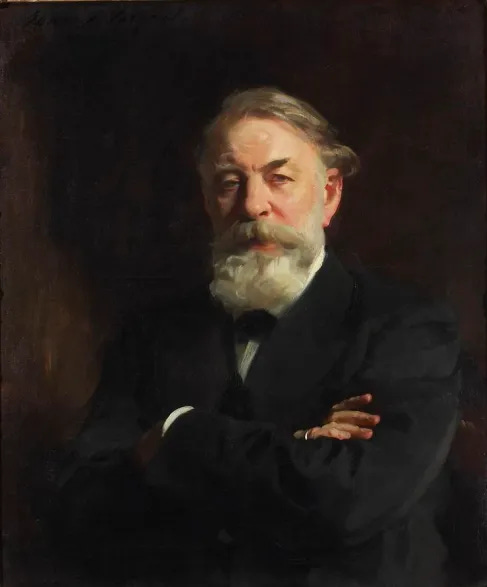
Gluck’s artistic formation was shaped by a constellation of painters who valued observation, psychological depth, and the integrity of the painted surface. Foremost among the early influences was John Singer Sargent, the American-born portraitist whose mastery of confident brushwork, dramatic tonal contrast, and psychological penetration in portraiture set a standard that Gluck aspired to from the beginning of their career. Sargent’s portrait of the musician Joseph Joachim was, by Gluck’s own account, the painting that decided their vocation, a choice of painting over singing that turned out to be a choice toward one kind of identity-making over another. William Nicholson was another significant early touchstone, particularly for the way his work handled dark backgrounds and simplified forms to achieve concentrated, precise characterizations. These influences are visible in Gluck’s earliest known work and persisted in the uncompromising directness of their portraiture throughout the following decades.
“Suddenly I faced the only photograph of a painting in the room – Sargent’s portrait of Joachim. There was a great swirl of paint and this hit me plumb in the solar plexus. All thoughts of being a singer vanished. The sensuous swirl of paint told me what I cared for most.”
— Gluck
The Newlyn and Lamorna painters like Alfred Munnings, Laura and Harold Knight, and Lamorna Birch gave Gluck a grounding in plein air realism and the particular handling of natural light that would characterize their landscapes and outdoor scenes. But perhaps the more lasting formative influence from this period was Romaine Brooks, the American expatriate painter whom Gluck met in 1923 and who painted Gluck as ‘Peter, A Young English Girl’, a portrait whose deliberate androgyny was widely noted and commented upon. Brooks worked in a subdued, near-monochromatic palette, her portraits characterized by restraint, introspection, and an elegiac quality that seems to speak always of social transgression held quietly beneath the surface. The subdued, precise color palette of Gluck’s own portraits, particularly their self-portraits, shows the deep imprint of Brooks’s approach.


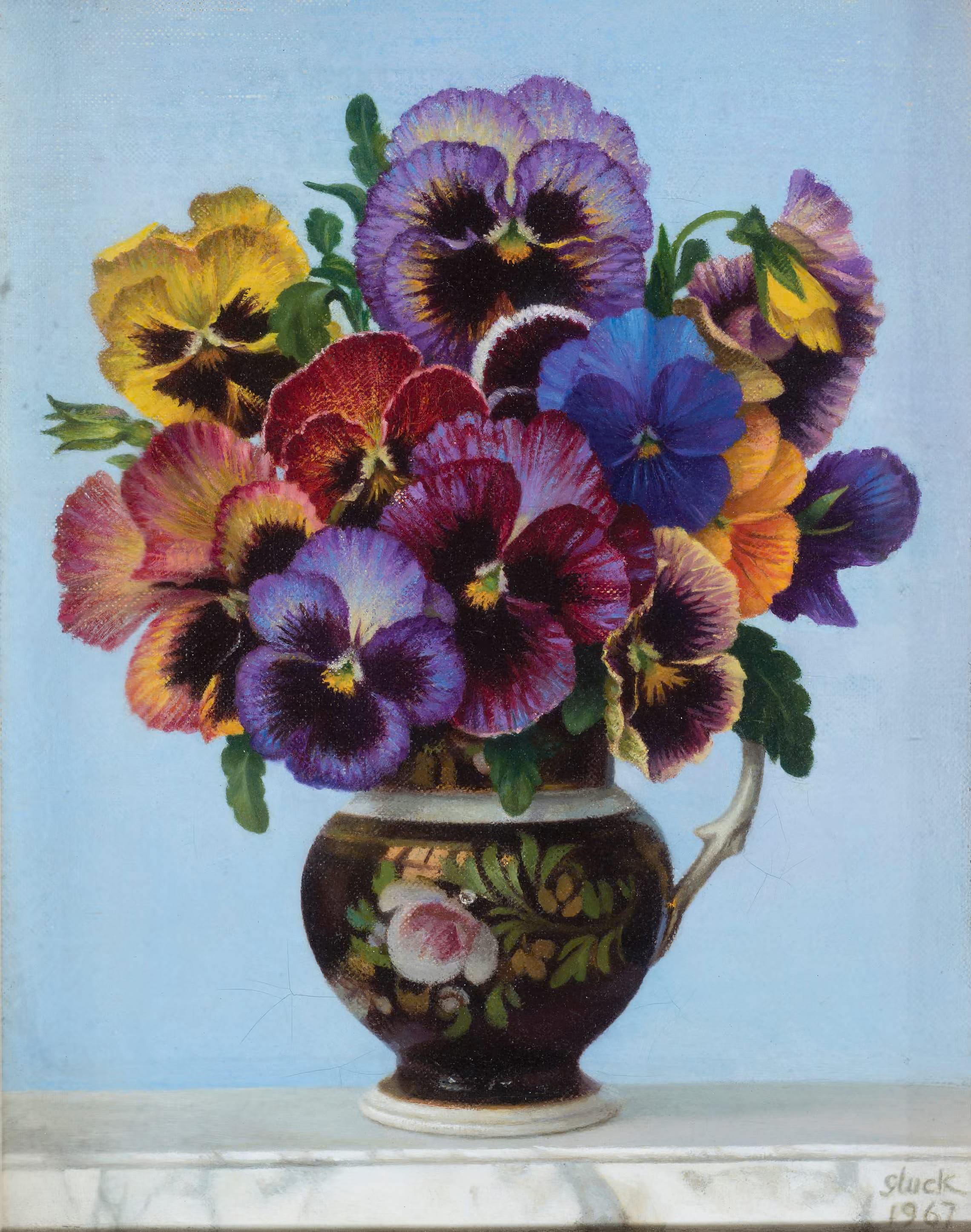
The relationship with florist and decorator Constance Spry (1932–1936) produced what is in some ways the most distinctive strand of Gluck’s mature work: the large floral still-lifes for which they became especially celebrated. Spry’s arrangements, abundant, architecturally complex, and charged with an erotic sensibility, gave Gluck both a subject and a collaborator. The resulting paintings, with their carefully observed light falling across white petals and cool backgrounds of cream, black, and blue, carry a quality critics and scholars have compared to Georgia O’Keeffe’s flower paintings: sensuous, ambiguous, simultaneously decorative and deeply personal. The eroticism is not incidental but structural, these are paintings of love objects, and the women they represent permeated Gluck’s visual imagination entirely.
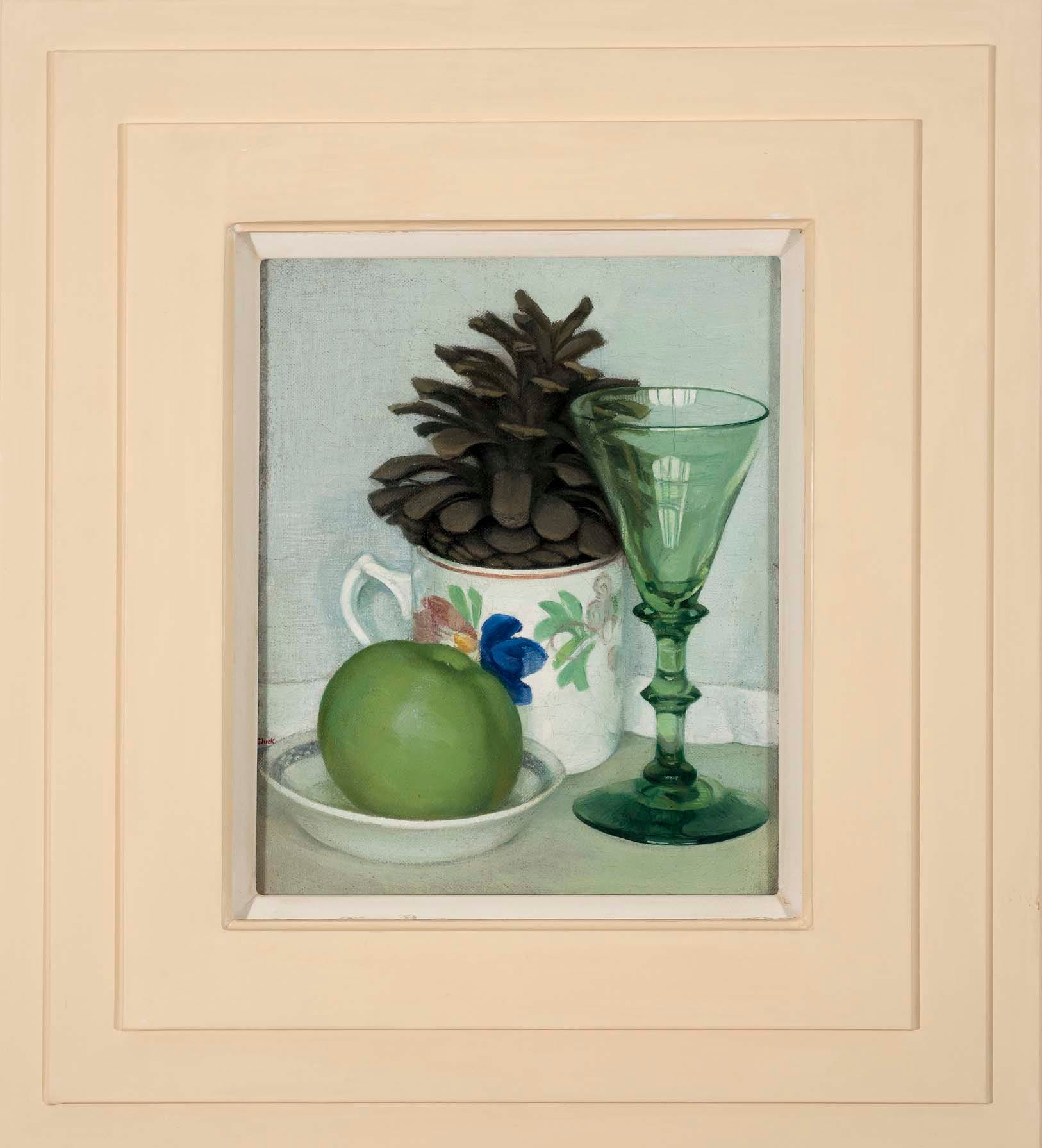
In terms of compositional and stylistic approach, Gluck was emphatically not affiliated with any movement. They identified with no artistic school, refused group shows categorically, and regarded their aesthetic as entirely self-made. The result is a body of work that occupies an intriguing position between figuration and modernism: technically accomplished in a traditional sense, but with a formal economy and psychological concentration that aligns it with the best modernist portraiture of the period. The three-tiered Gluck frame, patented in 1932 and used for all their exhibitions, extended this aesthetic philosophy into the exhibition space itself, blurring the boundary between painting and architecture and insisting that the work be encountered on its own terms, integrated into the world rather than isolated from it.
Art + Identity
In the early twentieth century, the very notion that an artist’s identity, their gendered self, their sexuality, and their presentation might be inseparable from their work was not a commonplace. Art was supposed to transcend the personal, to achieve a universality that rendered biographical detail irrelevant. Gluck not only rejected this idea but actively reversed it: the more completely Gluck’s art expressed a specific, particular, insistently personal identity, the more universal and resonant it became. Every canvas Gluck showed came embedded in a context, the Gluck frame, the solo show, the name and quote on the back of the print, that said: this work is made by a specific person, and that person cannot be edited out without destroying what the work means.
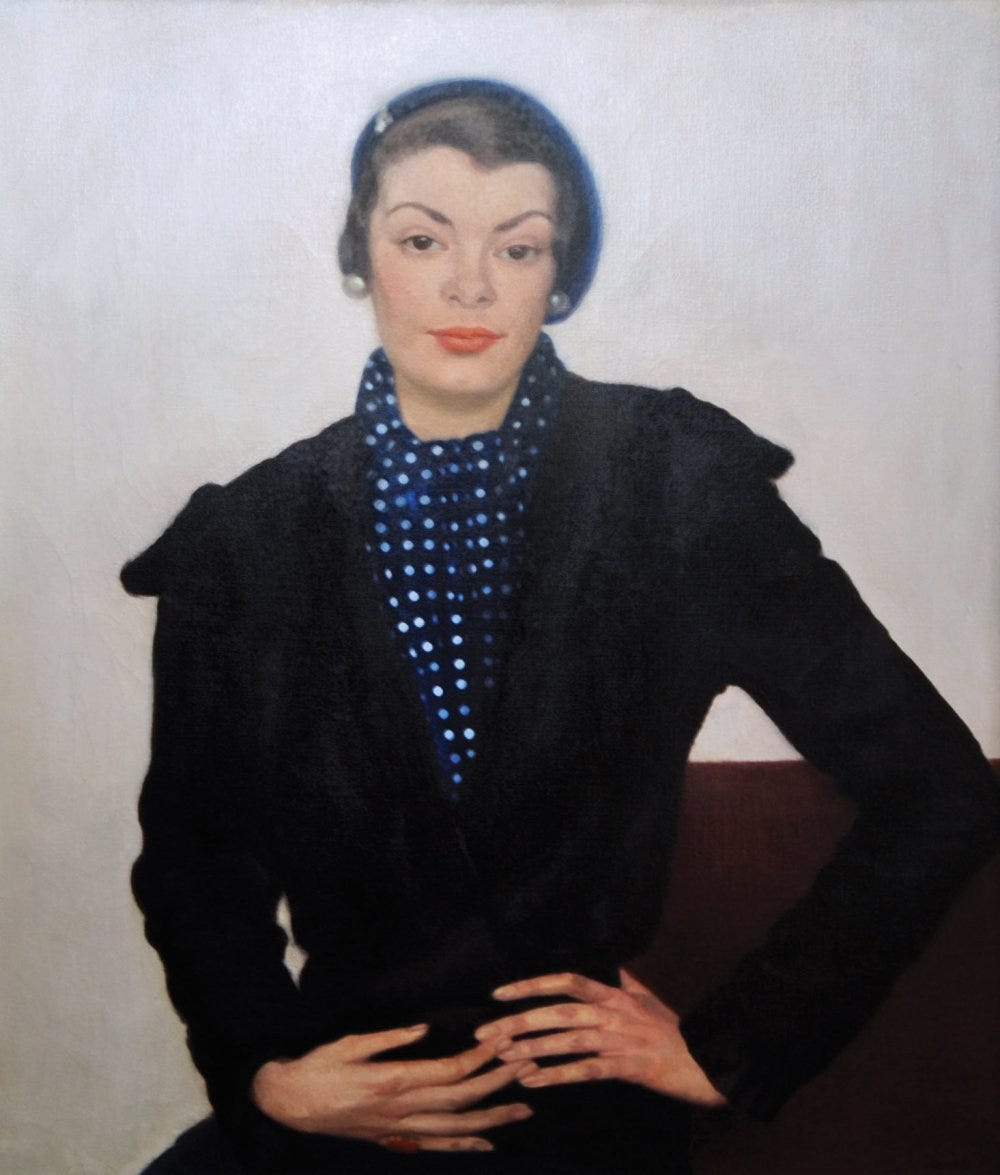
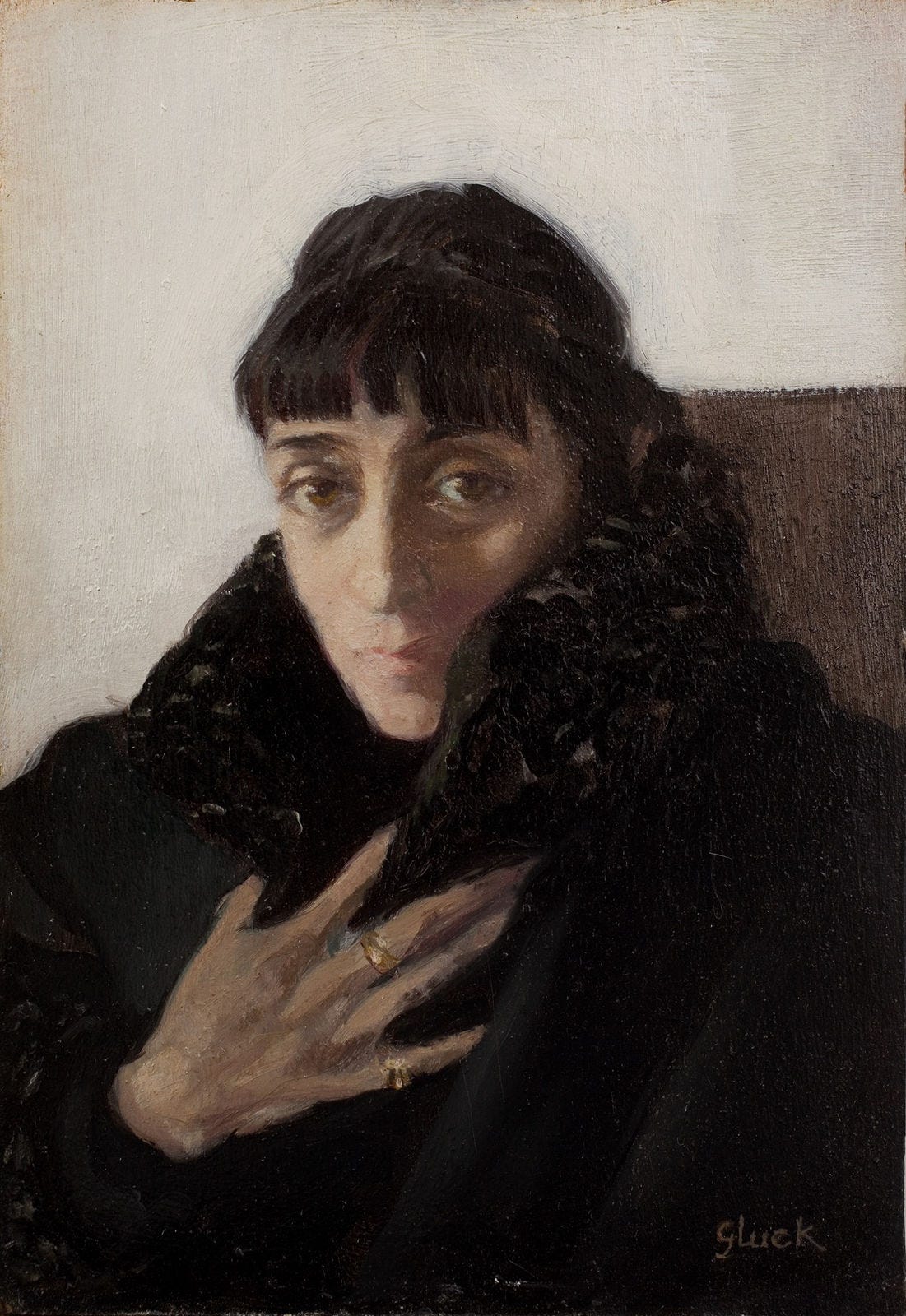
The self as art project was never more explicit than in the series of self-portraits Gluck produced across their career. From early images showing a confident, stylishly masculine figure looking levelly at the viewer, to the 1942 self-portrait, tense, a little haggard, eyes downward and inward, the portraits trace a life lived at the intersection of creative ambition and emotional intensity. The 1942 portrait was painted in a period of crisis, as Gluck’s relationship with Nesta Obermer was disintegrating, and it shows: this is not a portrait of a triumphant gender pioneer but of a suffering human being, worn by love and loss and the effort of maintaining an identity that the world has never made easy.
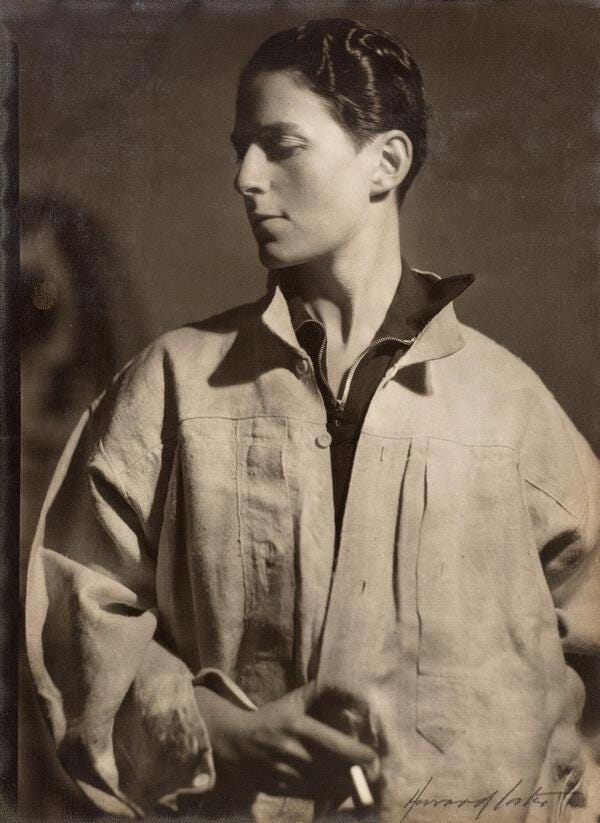
Gluck’s clothing and appearance were, as the Brighton Museum exhibition made abundantly clear, themselves a form of artistic production. In 1977, a year before their death, Gluck donated fifty-seven garments and accessories to Brighton Museum, men’s shoes from Fortnum & Mason, a silk scarf sewn into a cravat, traditional Tunisian menswear worn on holiday in Hammamet, a linen smock. Each item was as carefully chosen as a brushstroke. Howard Coster, the photographer who described himself as ‘photographer of men,’ captured Gluck in 1932 in that smock, the broad shoulders and strong jawline composing a figure that was emphatically not performing femininity. The image is as much a portrait of an identity as any painted self-portrait, and it was constructed with the same precision.


What is perhaps most striking about Gluck’s equation of art and identity, particularly given the historical moment in which it was made, is how methodically, persistently, and publicly it was maintained. At a time when same-sex relationships between women carried enormous social risk, and when gender nonconforming appearance could invite harassment, ridicule, or worse, Gluck did not hide. They showed at the Fine Art Society on Bond Street. They were visited by Queen Mary. They posed for Tatler. The society painter and the genderqueer pioneer were not two different things, they were one person, insisting on being seen as one whole.
Art + Activism
Gluck’s art was activist not in the sense of being didactic or programmatic, but in the deeper sense of making existence itself an argument. Every aspect of how Gluck showed their work, the framing, the naming, the solo exhibitions, the refusal of any prefix, constituted a sustained claim about what an artist was and could be: not a ‘lady painter,’ not ‘Miss Gluckstein,’ not a member of any school or movement, but simply Gluck, a singular intelligence and sensibility that owed its allegiances to no one. This was activist art before the term existed, the use of an artistic career and public visibility as the means to insist on a form of selfhood that society had no category for and no desire to accommodate.
In the letter Gluck wrote to Nesta Obermer upon completing Medallion, the activist dimension surfaces in language as clear and defiant as anything in Gluck’s story: ‘Now it is out, and to the rest of the Universe, I call Beware! Beware! We are not to be trifled with.’ The painting is, in these terms, not merely a love portrait but a declaration of war, a statement that the love between two women is real, visible, and not subject to erasure. Painted in 1936, when male homosexuality was a criminal offense and lesbianism existed in a strange liminal space between illegality and official denial, Medallion asked its viewers to look at two women in love and know it for what it was. The fact that it hung in a gallery visited by the Queen only makes the defiance more extraordinary.
Gluck’s relationship with the language of identity was itself a form of activism that resonates with remarkable contemporaneity. The refusal of all gendered honorifics, the adoption of a single genderless name, the insistence on ‘one-man shows’, all of these gestures constitute a sustained challenge to the grammar of gender that organized social life in early and mid twentieth-century Britain. When the Fine Art Society referred to Gluck on official correspondence as ‘Miss Gluck,’ the response was not a polite correction but an immediate resignation. The message was clear: this was not a negotiable matter of personal preference but a question of basic respect for the self Gluck had constructed and the identity they inhabited. The fact that most people around Gluck had no language for what they were witnessing does not mean they were not witnessing it.
In the 1950s, dissatisfied with the quality of commercially available artists' paints, Gluck launched what became known as their "paint war", a meticulous, decade-long campaign to raise the standards of artists' materials in Britain. The grievances were specific and technical: certain paints were grainy in consistency, some appeared to change color depending on the direction of the brushstroke, others took too long to dry or looked, as Gluck described it, simply "dead" on the canvas. For an artist whose entire practice was built on precision, control, and the conviction that a painting must endure exactly as its maker intended, these were not minor inconveniences but fundamental violations of artistic integrity. Gluck lobbied manufacturers, consulted scientists, and ultimately persuaded the British Standards Institution to establish a new official standard for oil paints, a genuine, lasting victory. The irony was not lost on those who admired Gluck's work: the campaign consumed the better part of a decade, during which painting itself was largely set aside. It was, in its way, entirely characteristic, a battle taken on with total commitment, fought on principle rather than convenience, and won. The paint war was just activism by another name.

Significant Works
Gluck, 1942
The 1942 self-portrait, Gluck, was painted at one of the lowest points of Gluck’s life. The relationship with Nesta Obermer, the great consuming love that had produced Medallion and the “YouWe” painting, that had reorganized Gluck’s entire emotional and social world, that Gluck had declared a marriage, was in its final, painful dissolution. Nesta, who had never left her legal husband and whose position in society made open acknowledgment of the relationship impossible, was pulling away, and Gluck, characteristically, was responding with an intensity that only accelerated the withdrawal. The war had dismantled the glittering interwar social world in which Gluck had flourished; Bolton House had been requisitioned; the Fine Art Society exhibitions, the society portraits, the world of Constance Spry and fashionable London interiors, all of it had receded. What remained, in a cottage in Plumpton within reach of Nesta’s family home, was Gluck alone with their grief and, eventually, a canvas. The self-portrait that resulted is not a record of triumph or self-presentation in the way that Gluck’s earlier public image had been. It is something rawer and more honest: a document of what it looks like to be a person who has staked everything on love and identity and is now reckoning, in private, with the cost.
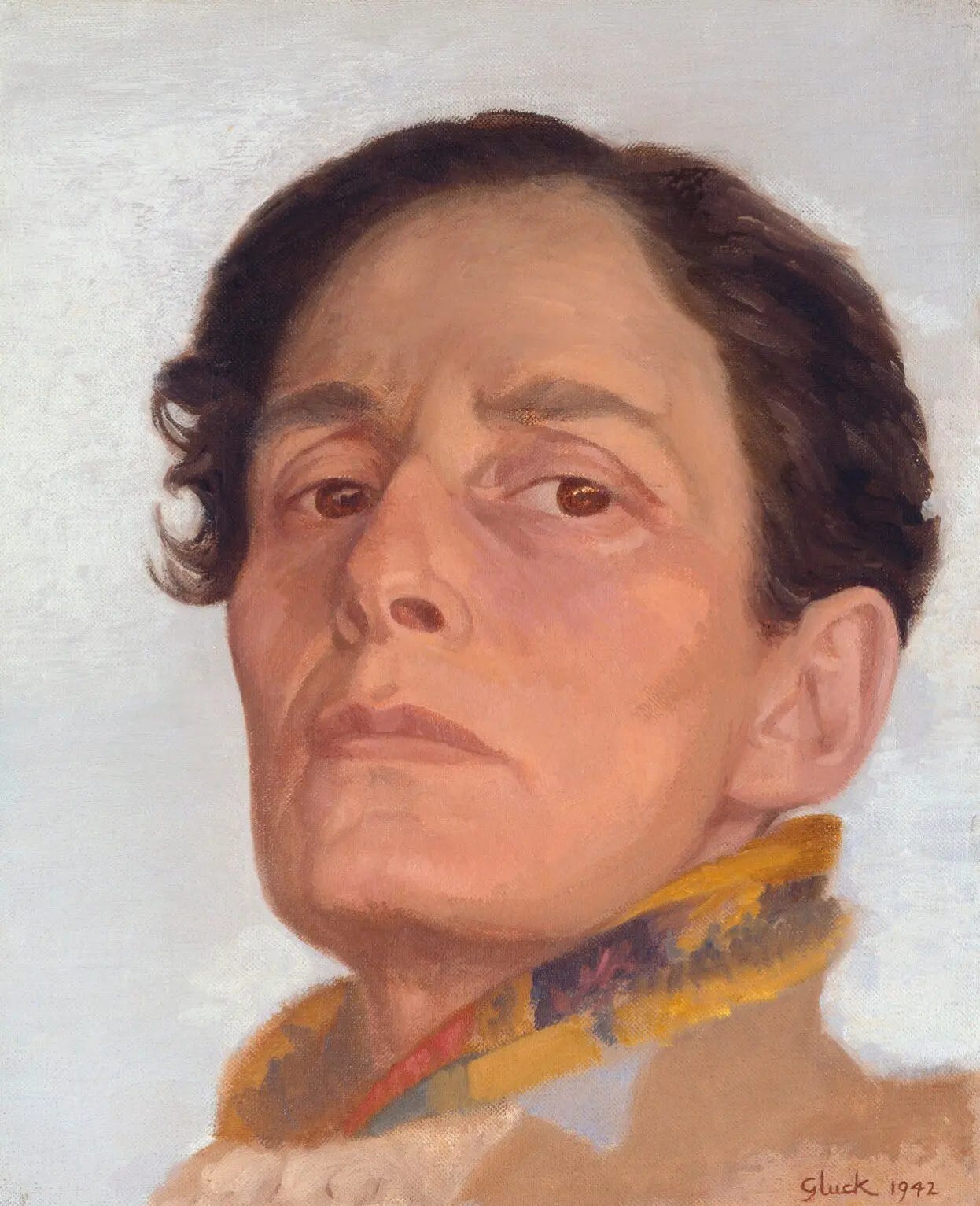
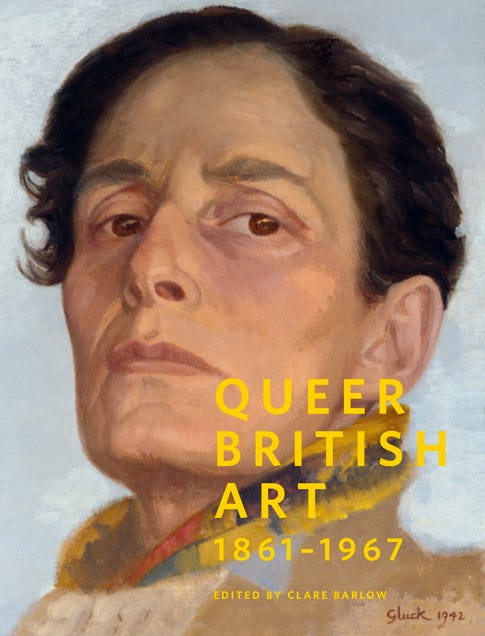
The painting itself is a study in controlled anguish. The jutting jaw and tilted head project the defiance that had always characterized Gluck’s public bearing, the mononym, the resignation from the art society, the Beware! of the letter to Nesta, but the eyes do not match. They are turned slightly downward and inward, carrying a weight that the chin’s defiant angle cannot quite counteract. The figure is rendered with Gluck’s characteristic precision and economy: light background, strong tonal contrasts, the sitter occupying the frame with a physical authority that nevertheless cannot entirely conceal the fragility beneath. It is a portrait of someone maintaining their composure, which is a different and more complex thing than a portrait of someone who is composed. The technical accomplishment is seamless, the brushwork controlled, the light exact, and this seamlessness is itself part of the painting’s meaning: Gluck did not allow grief to make the work worse. If anything, the concentration required to paint this well under these conditions gives the image its specific, almost unbearable quality of self-witnessing.
It is not a painting about pride in the contemporary sense. It is a painting about the cost of visibility, the weight of self-definition sustained across decades in a world that has never made it easy, and the refusal, stubborn, quiet, absolute, to be anyone other than exactly who you are.
Medallion (YouWe), 1936
Medallion (YouWe) (1936) was born from a single transcendent evening. On June 23, 1936, Gluck and their beloved Nesta Obermer attended Fritz Busch’s production of Mozart’s Don Giovanni at Glyndebourne, sitting together in the third row of the stalls. Biographer Diana Souhami describes how the intensity of the music seemed to fuse the two lovers into a single being, an experience of absolute union that Gluck immediately wanted to fix in paint. The resulting work shows the two figures in close profile, their outlines overlapping against a sky deepening toward darkness, gazing outward beyond the frame with a shared, composed authority. Gluck called it the “YouWe” picture, a word they invented to describe a state of mutual dissolution, two selves that had become, at least in that moment and in that marriage of paint, one. They later declared May 25, 1936, the weekend they had first spent together at Nesta’s family home at Mill House, their wedding day, and Medallion was the marriage portrait.
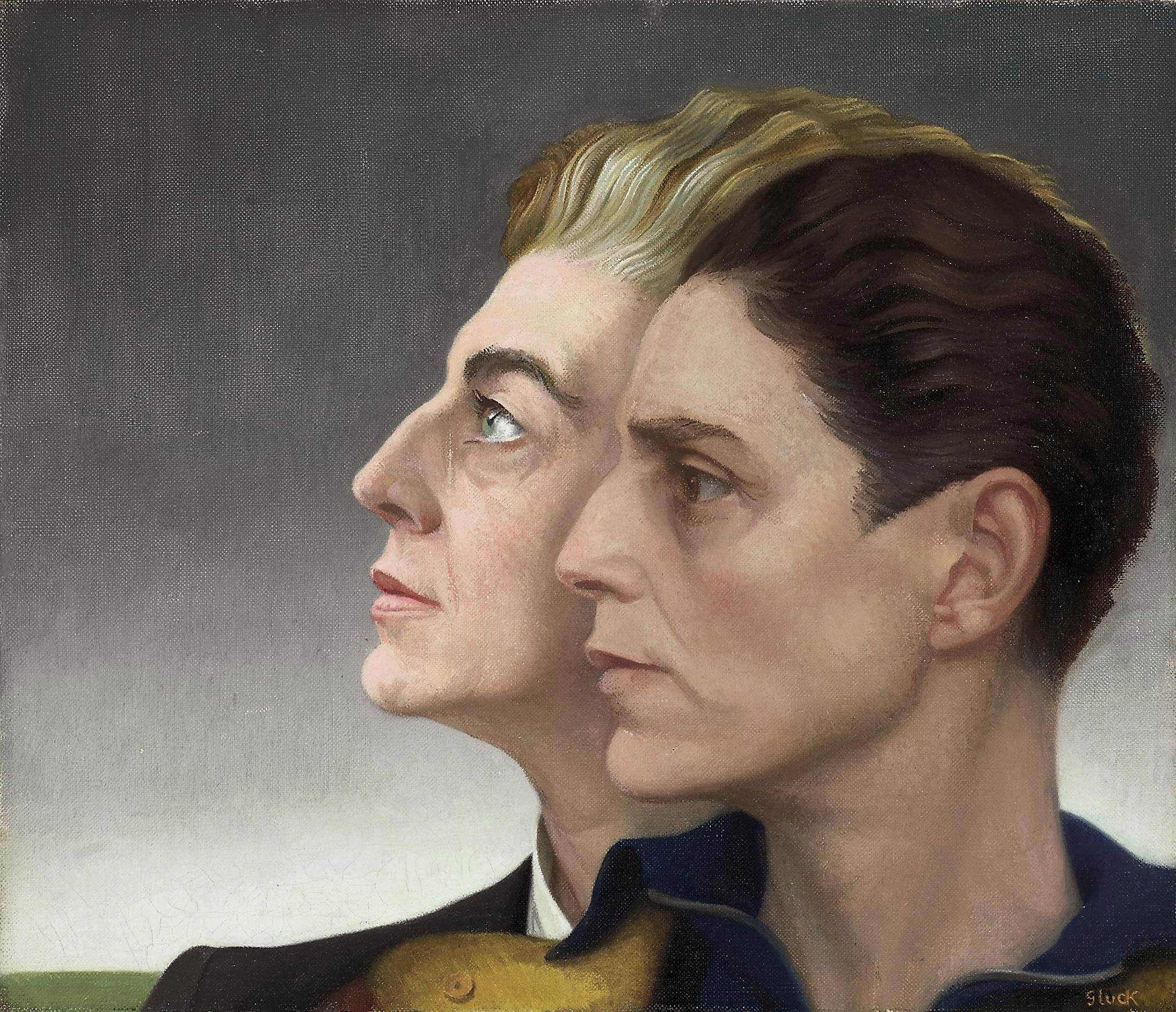
The painting’s formal qualities are inseparable from its meaning. At just twelve by fourteen inches, it is a small work that contains an enormous claim. The two profiles, Gluck’s stronger, more angular features beside Nesta’s softer ones, are rendered with an economy of line and a precision of observation that gives the composition a quality almost of heraldry: a seal, a crest, a coat of arms for a relationship that society offered no official recognition or vocabulary. The sky behind them is not a backdrop but a climate, dark, open, infinite, suggesting that the two figures exist not in a domestic or social space but in something larger and more elemental. There is nothing apologetic or hidden in the image. Both figures look outward with the same calm, combined gaze, as if daring the viewer to misunderstand what they are seeing. Gluck’s letter to Nesta upon completing the painting makes the defiance explicit: “Now it is out, and to the rest of the Universe, I call Beware! Beware! We are not to be trifled with.”
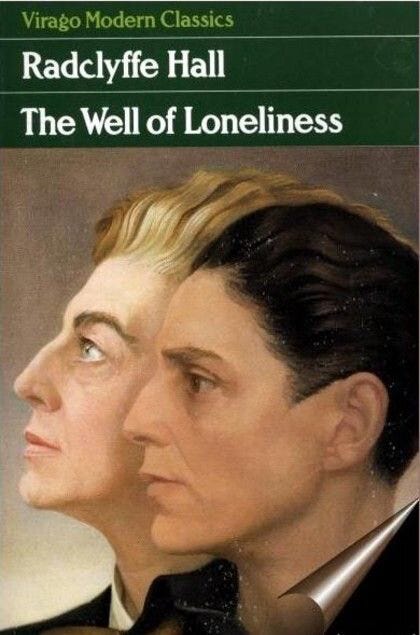
The painting’s power was real, but its full meaning had to wait for a world that could receive it. That world arrived, partially, in 1982, when Virago Press chose Medallion as the cover image for their mass-market paperback of Radclyffe Hall’s The Well of Loneliness, the most celebrated lesbian novel in the English language, itself a victim of obscenity proceedings on its original publication in 1928. Virago reprinted that edition eight times in eight years, placing Medallion on hundreds of thousands of copies and transforming it into one of the most widely seen depictions of a same-sex relationship in existence.
The painting’s afterlife has only continued to deepen its significance. Tate Britain’s landmark 2017 exhibition Queer British Art 1861–1967, marking fifty years since the partial decriminalization of homosexuality, drew directly on Medallion’s iconography and legacy, and Gluck’s 1942 Self-Portrait, painted in the grief of breaking up with Nesta, was chosen as the exhibition’s poster image, cementing the connection between Gluck’s work and the broader history of queer visibility in Britain. The 2017–18 Brighton Museum retrospective Gluck: Art and Identity gave Medallion the full scholarly and curatorial treatment it deserved, presenting it alongside Gluck’s letters, wardrobe, and personal archive as the centerpiece of a life in which art and identity were never separable. Today, Medallion is recognized not merely as Gluck’s masterwork but as one of the foundational documents of queer British art, a painting made in love, made in defiance, and made to last. The universe was warned. It has been listening ever since.
Floral Series, 1932-1967
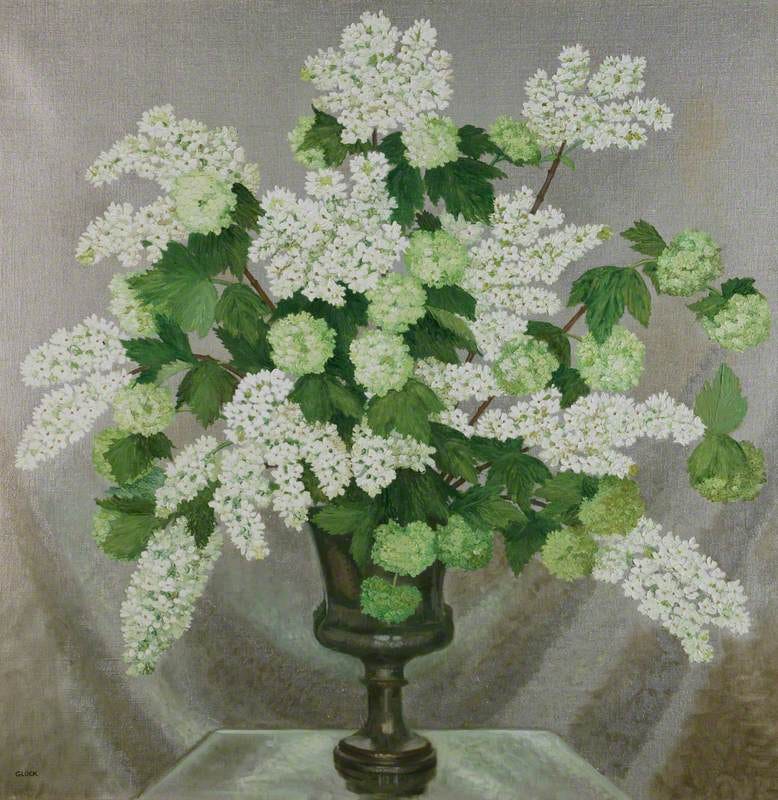
Gluck’s floral paintings of the early 1930s were not created through artistic calculation but through love. The relationship that produced them began around 1932, when Gluck became romantically involved with Constance Spry, a woman who was, by that point, already transforming the world of floral design in Britain. Spry had built a reputation for arrangements that broke the rigid, formal conventions of Victorian and Edwardian floristry: she raided vegetable gardens and hedgerows, used kale and artichokes and wild grasses alongside hothouse blooms, and composed arrangements of startling architectural complexity and sensuous abundance. Her work was commissioned for debutante balls, upmarket shop windows, and the grandest social occasions in interwar Britain, but it carried, in Gluck’s eyes, something far beyond decorative function. It carried Spry’s own personality: bold, unconventional, and charged with a specific erotic vitality that Gluck immediately recognized as the visual language of their own inner world. The flowers were Spry. To paint them was an act of attention that was also an act of devotion.


The paintings that resulted are among the most technically accomplished works in Gluck’s entire output. Large by Gluck’s standards, who typically worked with great restraint of scale, they place Spry’s arrangements against cool, clean backgrounds of cream, black, and blue that allow the flowers to occupy the visual field with a kind of sovereign authority. The light across the petals is observed with extraordinary patience: the way a white flower catches and refracts illumination, the slight translucency at the petal’s edge, the dense shadow pooling at the base of an arrangement. Works like Lilac and Guelder Rose, shown at the 1937 Fine Art Society exhibition, prompted Lord Villiers to remark that he felt he could bury his face in the canvas, a response that captures precisely what these paintings do, which is to make the tactile, olfactory, embodied experience of being near flowers available through purely visual means. The Devil’s Altar (1932), depicting Spry’s favourite flower, Brugmansia, the angel’s trumpet, in an arrangement of haunting, slightly ominous beauty, is perhaps the most charged of the series: the flowers hang heavy and pendulous, beautiful and faintly dangerous, suffused with a quality that sits somewhere between the sacred and the erotic.


The comparison to Georgia O’Keeffe, which critics and scholars have drawn repeatedly, is instructive. Like O’Keeffe’s large-scale flower canvases of the same period, Gluck’s floral paintings use the formal language of botanical observation as a vehicle for something considerably more personal and intimate, a way of expressing, under the socially permissible cover of still-life painting, feelings and states of being that could not be named directly in public. Both painters understood that flowers, in the Western visual tradition, carry an accumulated freight of associations, with desire, fertility, transience, the body, that the artist can activate or redirect without ever stating explicitly what they are doing. For Gluck, the flowers were also portraits: portraits of Spry’s hands and imagination, portraits of a specific kind of love being lived in a specific historical moment when that love had no publicly sanctioned form. The paintings are tender in exactly the way that private things, rendered in art, can be tender, with an intimacy that survives the death of the relationship that created them.


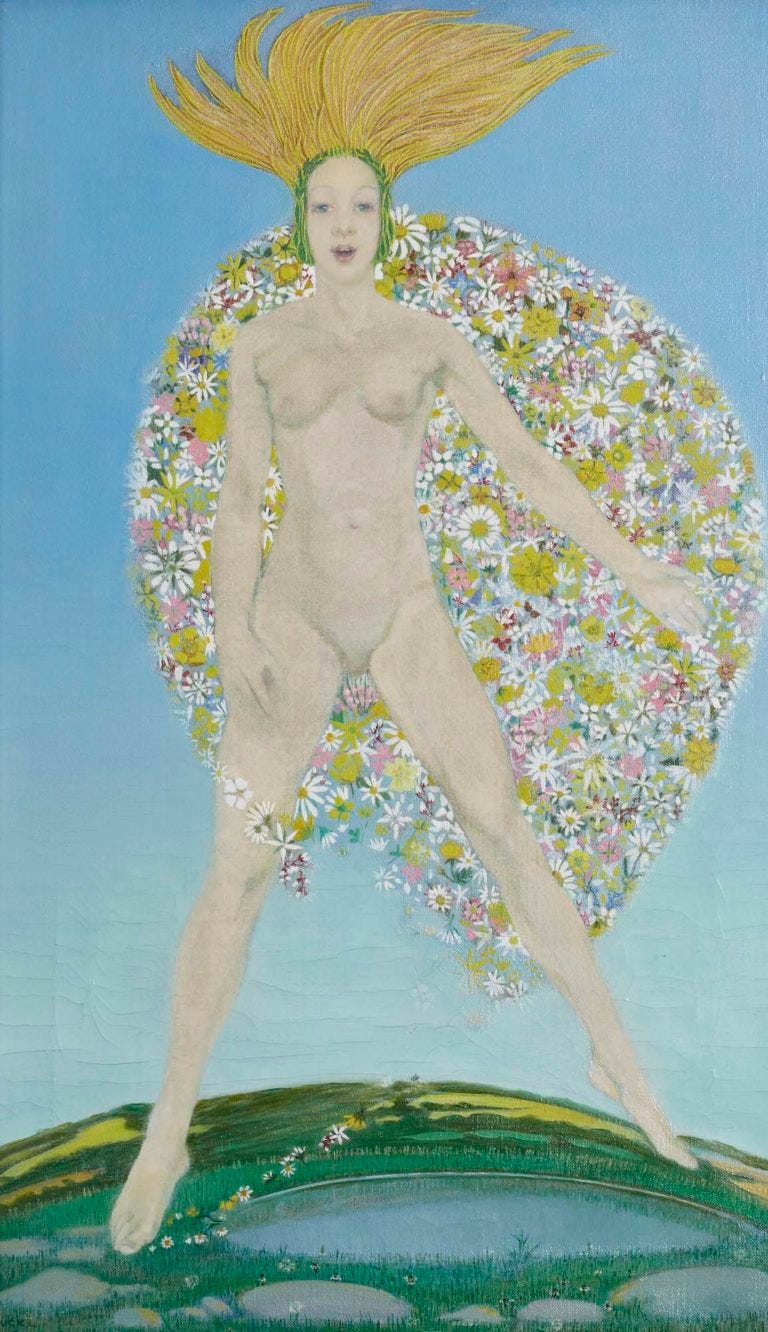
Interior designer Syrie Maugham was among the first prominent voices to recognize the commercial and aesthetic power of these works, using Gluck’s floral paintings extensively in her celebrated all-white interiors and bringing them to the attention of fashionable clients across Britain. Spry herself used them to illustrate her articles on floral design. That commercial and social success gave the paintings a double life: publicly, they circulated as exquisite examples of a particular strain of modernist decorative art; privately, they were love objects, made by someone in love, saturated with the specific quality of attention that belongs to that condition. When the relationship with Spry ended, superseded by the overwhelming passion for Nesta Obermer that arrived in 1936, Gluck stopped painting flowers, at least with the same intensity. The series stands, therefore, as a complete and self-contained record of a particular chapter of Gluck’s emotional and artistic life: a love affair conducted in paint, on canvas, with white petals and cool light, offered to the world under the respectable name of still-life, and unmistakably, quietly, a declaration.

Recent/Upcoming Exhibitions
Gluck: Art and Identity - Brighton Museum & Art Gallery - Brighton and Hove, England (Nov 18, 2017 - Mar 11, 2018)
Gluck: Art and Identity was, as curator Martin Pel described it, the world’s first exhibition to explore both the life and artwork of Gluck in full, and the way it came about is itself revealing. The curatorial team of Pel, Professor Amy de la Haye of the London College of Fashion, and exhibition-maker Jeffrey Horsley, originally began by looking at Gluck’s clothing within a context of LGBTQIA2S+ identity, asking how a queer individual constructs a self through dress, and finding in Gluck the perfect example. The starting point was a discovery: during a collection review of the fashion and textiles holdings at Brighton Museum, de la Haye and Pel found a store of beautiful dresses somewhat surprisingly attributed to Gluck, who was renowned for their masculine dress and androgynous look. This was the thread that unraveled everything. Those dresses, some almost certainly belonging to Gluck’s lovers, others to Gluck themselves, their silhouettes and fabrics carrying the complexity and richness of a queer life lived across decades, became the anchor for an exhibition that refused to separate the artist from the person, the paintings from the clothes, the public persona from the intimate archive.
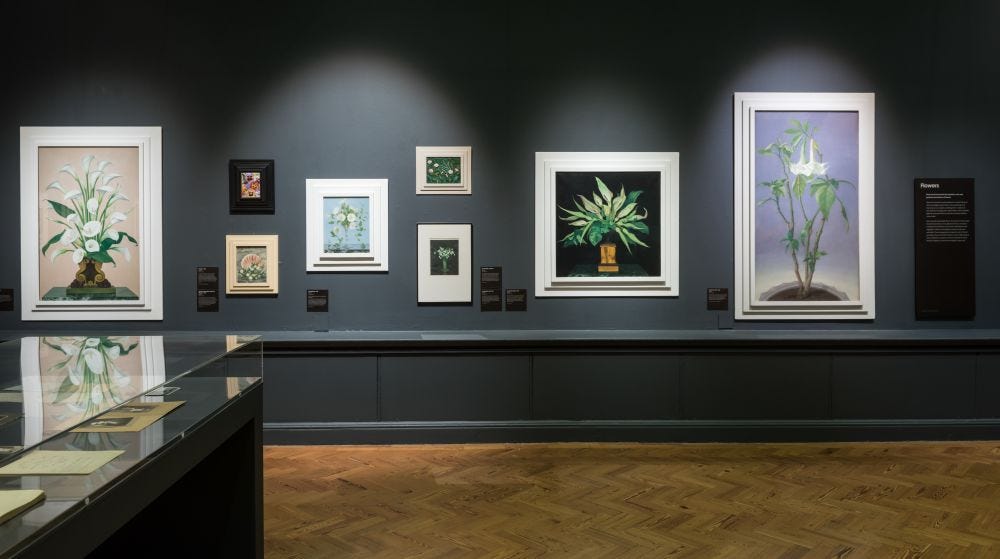
The exhibition was part of a wider project called Wear It Out, which explored the cultural heritage of dress of LGBTQIA2S+ communities in Sussex from 1917 to 2017, examining how dress is used to express the identities and sexualities of individuals who identify as LGBTQIA2S+, funded by the Heritage Lottery Fund. Within that broader context, Gluck’s story carried particular weight: here was a person who had been doing precisely this work, using dress as a language of identity, since the 1920s, long before any theoretical or political framework existed to name it. The display of Gluck’s clothing in the exhibition’s second room made the material constituents of gender and queer aesthetics especially prominent, with two painter’s smocks, one iridescent silk, one plain linen, stimulating reflection on the relationship between Gluck’s public and private personas. Alongside these were the Tunisian menswear Gluck had worn on holiday in Hammamet in the 1930s, well-loved brown leather shoes from Fortnum & Mason, a red silk scarf sewn into a cravat, each object a small, precise declaration of self. The showcase also brought together thirty rarely seen artworks alongside extensive personal ephemera including love letters, personal photographs, and press clippings.
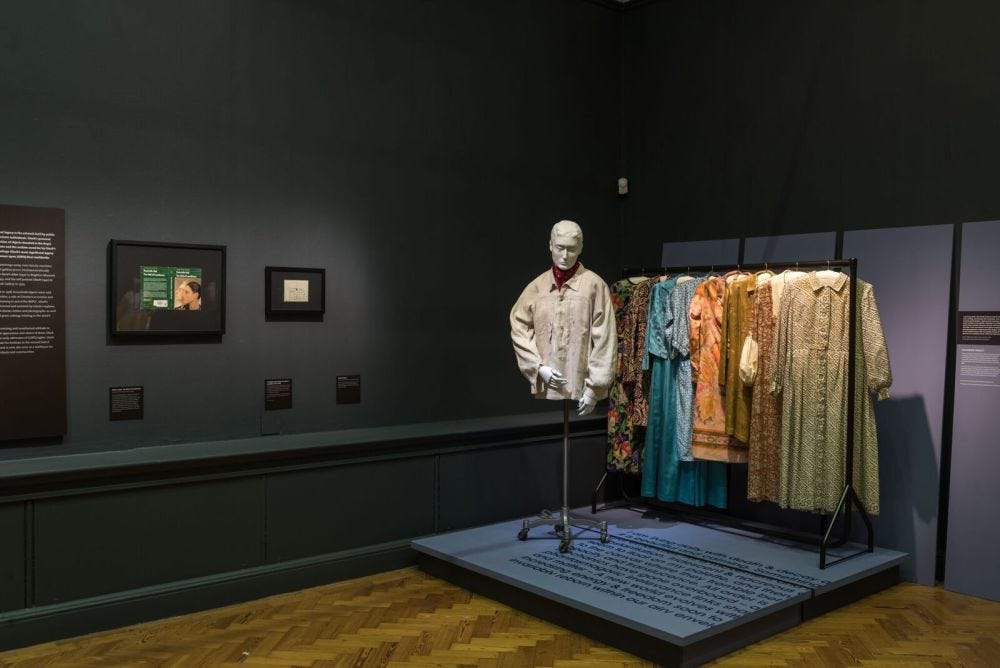
The significance of the Brighton exhibition went beyond the art historical. Martin Pel noted that Gluck’s artistic significance had arguably been obscured in the preceding fifty years by the artist’s role as a figurehead and pioneer of LGBTQIA2S+ lives, and that the exhibition aimed to survey both the personal narrative and the significance of the artworks within the history of twentieth-century British art. By presenting the paintings and the personal archive together, and by refusing, as Jeffrey Horsley described it, to follow a single definitive biographical narrative, instead allowing visitors to trace their own path through Gluck’s life, the exhibition made an argument about how queer history should be told: not as a neat progression toward visibility, but as a lived complexity full of dead ends, contradictions, and unanswered questions. The accompanying Yale University Press catalogue, edited by de la Haye and Pel, presented a major reassessment of Gluck’s life and work through richly illustrated contributions by experts in dress history, gender studies, and curatorship, and was described as a “superbly illustrated collection of essays.” Together, exhibition and catalogue established the scholarly and cultural infrastructure that Gluck’s reputation had long deserved and never quite received.
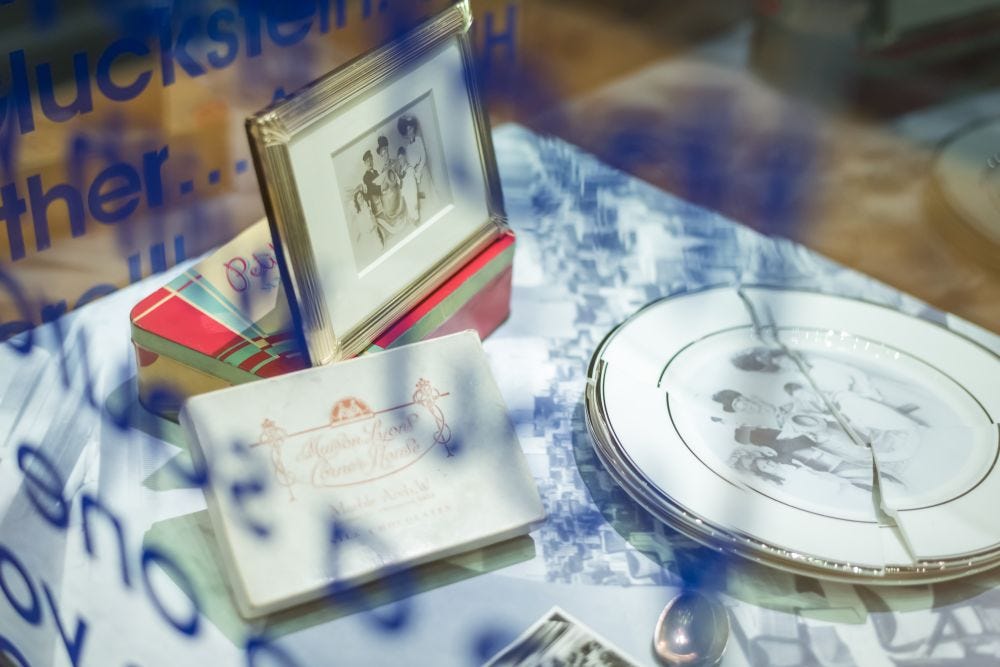
The Brighton retrospective did not emerge in isolation, it was the culmination of a long and uneven posthumous history of exhibition that tracked the fluctuating fortunes of Gluck’s reputation across the decades. The most important predecessor was Gluck’s own final solo exhibition at the Fine Art Society in 1973, which marked a triumphant return after thirty years of public absence and confirmed that the work had lost none of its authority. A memorial show at the same gallery in 1980 followed two years after Gluck’s death. The De La Warr Pavilion in Bexhill-on-Sea mounted a small but well-regarded exhibition in 1998, and the Fine Art Society staged a further retrospective in 2017, running concurrently with the Brighton show.
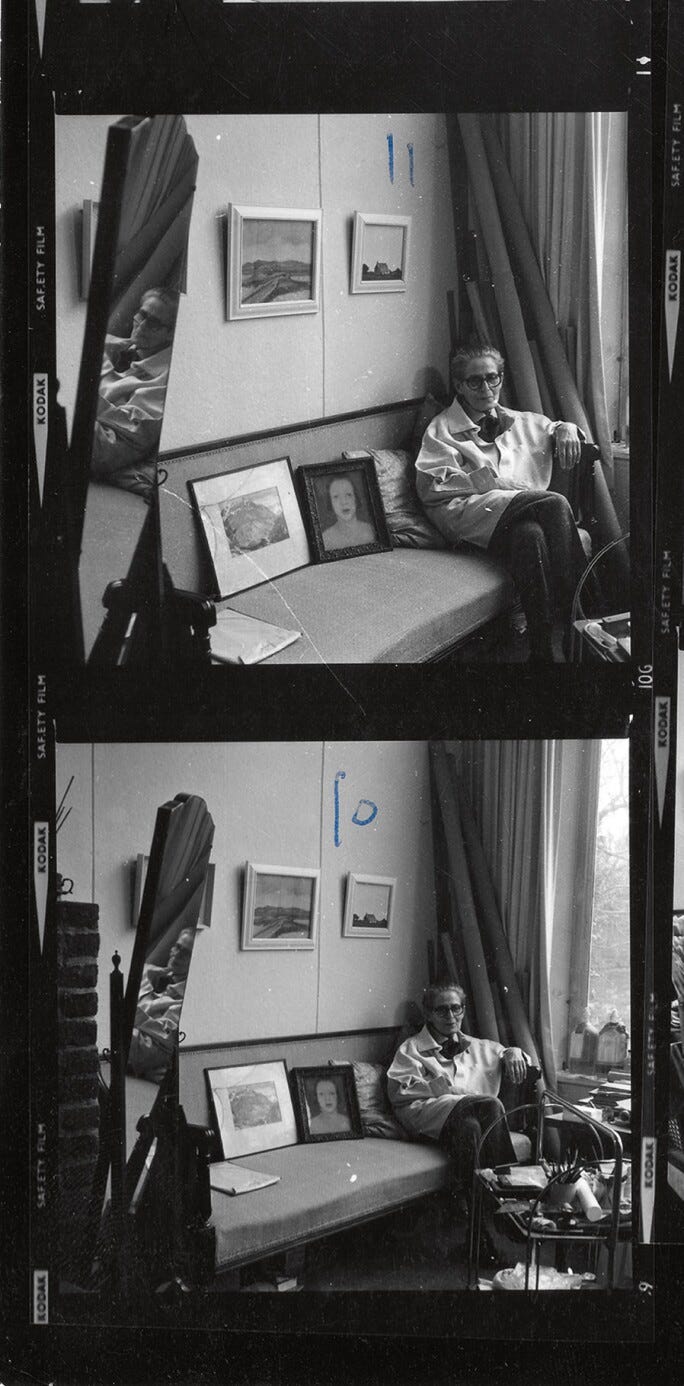
Most consequential of all, however, was Tate Britain’s Queer British Art 1861–1967 (2017), which paid tribute to the fiftieth anniversary of the Sexual Offences Act of 1967 and chose Gluck’s 1942 self-portrait as its poster image, a decision that placed Gluck at the symbolic center of a century of queer British artistic expression and introduced the work to an entirely new generation. In 2019, the Tate acquired Flora’s Cloak (c.1923) for its permanent collection, cementing Gluck’s institutional standing in Britain. Most recently, the Clark Art Institute’s 2025 exhibition A Room of Her Own: Women Artists-Activists in Britain, 1875–1945 included both Tulips and Medallion (YouWe), bringing Gluck to American audiences and situating the work within the longer tradition of women’s artistic activism, a framing that would, one imagines, have pleased an artist who spent their entire life insisting that art and identity were never, and could never be, two separate things.
Reflecting on Gluck’s Journey
Gluck’s life traces an arc that is at once uniquely particular, embedded in the specific social history of Britain between the 1890s and the 1970s, and universally legible as a story about selfhood, creativity, and the cost of living exactly as one is. They began as Hannah Gluckstein, born into the apex of British Jewish commercial society, and ended as Gluck, a single word worn smooth as a stone, containing everything that had been shed and everything that had been discovered. Between those two points lies a life of extraordinary creative intensity, passionate love, grinding artistic struggle, and a moral consistency that never bent to social pressure or artistic fashion. What Gluck set out to be, an artist on their own terms, they remained, through wealth and loss and thirty years of creative silence and a final triumphant return.
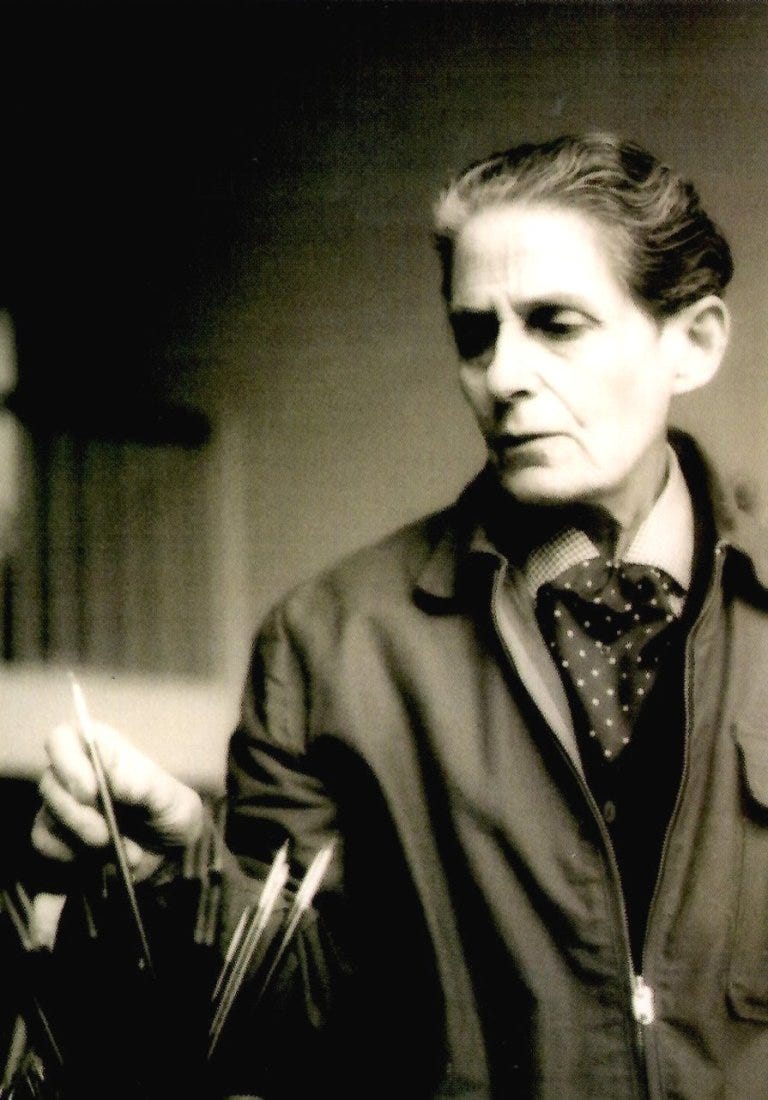
The silences in Gluck’s story are as significant as the paintings. The thirty-year hiatus following the collapse of the relationship with Nesta Obermer, the years of blocked creativity, the long campaign over paint quality, the depression and possessiveness and gradual withdrawal from the social world that had once sustained them, is not an interruption of Gluck’s story but a chapter of it, one that tells us something important about the intersection of love, identity, and artistic production. Gluck’s art was never autonomous from their emotional life: it grew from love, withered when love was lost, and found its way back only when Gluck found something else to be fierce about.
What is most remarkable about Gluck’s journey, viewed in retrospect, is the degree to which it prefigured conversations that would not enter mainstream cultural consciousness for decades. The refusal of gendered language; the insistence on identity as self-constructed rather than socially assigned; the visibility of same-sex love in public artistic life; the equation of dress, presentation, and bodily comportment with artistic and political meaning, all of these are recognizably contemporary concerns, and Gluck was enacting them in the 1920s. The current emphasis on LGBTQIA2S+ visibility, on the right to define oneself outside of binary gender categories, on the importance of queer art history: these movements have found in Gluck a forerunner who did not simply anticipate their concerns but lived them, daily, in a world that offered no theoretical support and considerable social danger.
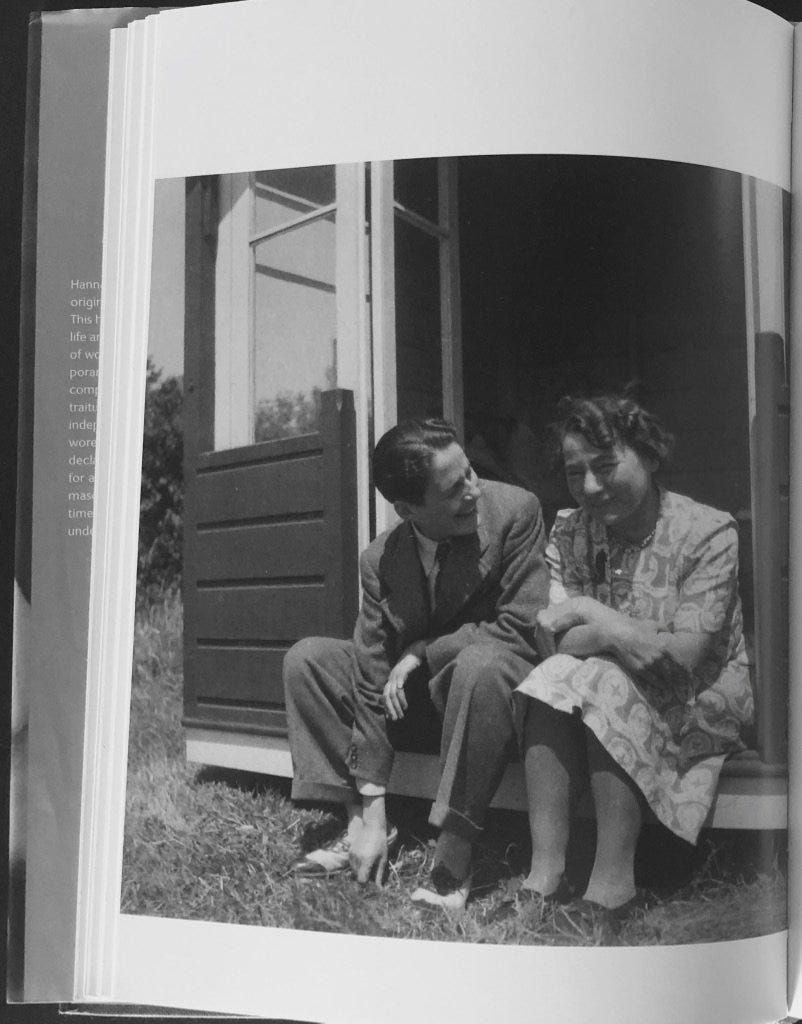
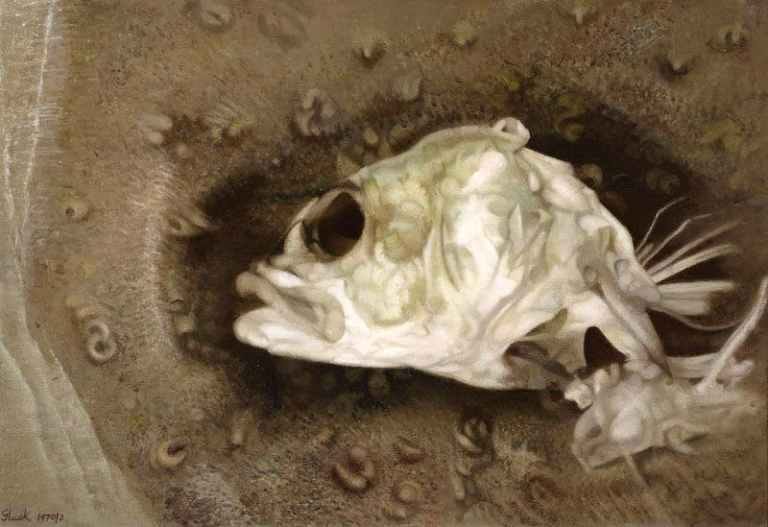
Gluck died in Steyning in 1978, in the house they had shared for thirty-four years with Edith Shackleton Heald, two years after Edith’s death. Their last major painting, completed five years before they died, was titled after a poem about refusing to go gently. It is the perfect final statement from an artist whose entire life had been organized around exactly that refusal. From the silver star at St Paul’s to the self-portrait that Tate Britain made the face of queer British art; from the running away to Cornwall with Craig to the bonfire of letters and early paintings that marked the beginning of the great love with Nesta; from the Gluck frame rising from the wall in three tiers to the skeletal fish head on the Sussex shore, Gluck raged, continuously and magnificently, against the dying of every light. The world, catching up at last, is grateful.
“…Do not go gentle into that good night,
Old age should burn and rave at close of day;
Rage, rage against the dying of the light…”— Dylan Thomas in his Do not go gentle into that good night poem