034. Tessa Boffin
Between Fantasy and Survival: Tessa Boffin's Visual Activism in Britain's AIDS Crisis
Introduction
Tessa Boffin was a pioneering British photographer and lesbian activist whose brief but explosive career between the mid-1980s and early 1990s left an indelible mark on queer visual culture. Working at the height of the AIDS crisis, Boffin created staged photographic fantasies that championed lesbian visibility and challenged the exclusion of women from safe sex discourse. Her work was revolutionary not just for its technical innovation and surrealist aesthetic, but for its unflinching commitment to making visible what society refused to acknowledge: lesbian desire, sexuality, and identity in all their complexity. Despite dying by suicide in 1993 at just 33 years old, Boffin’s legacy as an artist who refused to compromise her vision continues to resonate with contemporary queer artists and activists who recognize in her work a bold refusal to accept the limited representations available to lesbian women.
Tessa’s practice was characterized by carefully constructed studio photographs that blurred the boundaries between reality and fantasy, using historical references, critical theory, and deadpan humor to create alternative worlds where lesbian identity could flourish. At a time when most photographers had moved to street photography, Boffin deliberately chose the studio as her creative space, understanding that fantasy and imagination were essential tools for communities denied their own history and representation.
Her major series, including Angelic Rebels: Lesbians and Safer Sex (1989), The Knight’s Move (1990), and The Sailor and the Showgirl (1993), addressed critical issues from lesbian exclusion during the AIDS crisis to the construction of queer identity through reimagined historical narratives. Beyond her artistic practice, Boffin was also a crucial curator and organizer, co-curating landmark exhibitions like Ecstatic Antibodies: Resisting the AIDS Mythology (1990) with Sunil Gupta and Stolen Glances: Lesbians Take Photographs (1991) with Jean Fraser, both of which included seminal accompanying publications that remain essential texts in queer visual studies.
“However, we must not be content solely with delving into the past in order to find consoling elements to counteract the harm and under-representation, or mis-representation, we have suffered as a marginalised community. We cannot just innocently rediscover a lesbian Golden Age because our readings of history are always a history of the present, shaped by our positions in the present. We also have to re-invent, we have to produce ourselves through representations in the present, here and now. These images may transgressively take from others; but they will certainly shape our future and play with our desires.
— Tessa Boffin and Jean Fraser in Stolen Glances: Lesbians Take Photographs
Her photographs weren't documentary records but rather carefully composed fantasies that acknowledged their own constructed nature, creating alternative spaces of exploration, where queer women could see themselves reflected in ways that felt both aspirational and real. This approach was deeply connected to her activism and curatorial work, which sought to build archives and create communities around lesbian photography at a time when such images were systematically excluded from galleries, museums, and even many LGBTQIA2S+ spaces. Through both her art and her organizing, Tessa worked to ensure that lesbian desire and identity would not vanish from history, a fight that feels all the more poignant given how thoroughly her own work has been overlooked in the decades since her death.

Early Life and Background
Cultural and Personal Influences
Tessa Boffin was born in London in 1960, coming of age during a transformative period for both British culture and queer politics. Growing up in the aftermath of the 1967 Sexual Offences Act, which partially decriminalized homosexuality in England and Wales, Boffin experienced adolescence and early adulthood during a time when LGBTQIA2S+ communities were becoming more visible and organized, yet still faced tremendous social stigma and legal discrimination. The 1970s and early 1980s in Britain saw the rise of gay liberation movements alongside feminist activism, creating fertile ground for new forms of political and artistic expression. For young queer women like Tessa, these movements offered both community and conflict: lesbian feminists often found themselves marginalized within male-dominated gay rights organizations while simultaneously facing criticism from straight feminists uncomfortable with their sexuality. This double marginalization would profoundly shape Boffin’s artistic vision and political commitments.
Boffin’s personal background and family life remain relatively undocumented in available sources, reflecting both her own privacy and the ways in which queer histories have often been lost or overlooked. What is clear from her work and the testimony of those who knew her is that she was deeply embedded in London’s alternative cultural scenes from an early age. The Northern Irish poet Cherry Smyth, who knew Boffin personally, remembered her as a “walking, talking crisis of category...fascinating to witness,” suggesting someone who refused conventional categorizations and lived her identities fluidly and openly. This refusal of fixed categories extended to Tessa’s embrace of leather and BDSM culture, which became central not just to her personal life but to her artistic practice. At a time when lesbian feminism often promoted what Boffin saw as a sanitized, desexualized vision of lesbian identity, she insisted on representing lesbian desire in all its complexity, including fantasy, power dynamics, and unconventional expressions of sexuality.
The cultural landscape of London in the 1980s provided both inspiration and community for Boffin’s development as an artist. The city’s queer nightlife, particularly clubs like Purgatory where she later performed, offered spaces where alternative sexualities and gender expressions could be explored relatively safely. The era’s music and fashion scenes, from punk to new wave, celebrated transgression and challenged mainstream aesthetics in ways that resonated with Boffin’s own artistic sensibility. Meanwhile, Thatcher-era Britain’s conservative social policies and the moral panic around AIDS created an increasingly hostile environment for LGBTQIA2S+ people, making visible, unapologetic queer art not just aesthetically radical but politically dangerous. It was within this complex matrix of subcultural creativity and mainstream repression that Tessa forged her distinctive artistic voice.
Early Exposure to Art and Education
Tessa Boffin’s formal education in photography and critical theory provided her with the technical skills and intellectual frameworks that would define her artistic practice. She completed her BA (Hons) in Photographic Arts (Theory and Practice) from the Polytechnic of Central London (now University of Westminster) in 1986, at a time when the institution was at the forefront of conceptual and documentary photography in Britain. This program’s emphasis on both technical mastery and theoretical sophistication meant that Boffin was exposed not just to the mechanics of photography but to critical debates about representation, ideology, and the politics of the image.
The timing of Tessa's education was particularly significant. She completed her undergraduate degree in 1986, just as the AIDS crisis was beginning to devastate gay communities in Britain and as moral panic around sexuality was intensifying under Margaret Thatcher's government. These political conditions made questions about representation urgent and immediate: how LGBTQ people were portrayed (or more often, not portrayed) in media and culture had direct consequences for public policy, social attitudes, and the lived experiences of queer individuals. Boffin's theoretical education gave her frameworks for understanding these representational politics, while her practical training gave her the means to intervene in them. The combination would prove essential to her most significant work, particularly Angelic Rebels, which directly challenged the exclusion of lesbians from AIDS awareness campaigns by creating images that insisted on lesbian sexuality and lesbian vulnerability to HIV.
Following her undergraduate degree, Boffin pursued an MA in Critical Theory at the University of Sussex, further deepening her engagement with theoretical frameworks that would inform her artistic practice. This graduate work exposed her to feminist theory, queer theory, and critical approaches to visual culture at a crucial moment in the development of these fields. The 1980s saw the publication of landmark texts in feminist and queer studies, from Judith Butler’s early work on gender performativity to Eve Kosofsky Sedgwick’s theorizations of queer desire to Laura Mulvey’s influential essay on the male gaze in cinema. These theoretical interventions provided Tessa with conceptual tools for understanding how images could both reinforce and resist dominant ideologies around gender and sexuality. Her combination of rigorous theoretical training with practical photographic skills was relatively unusual and gave her work an intellectual depth that set it apart from much activist art of the period.
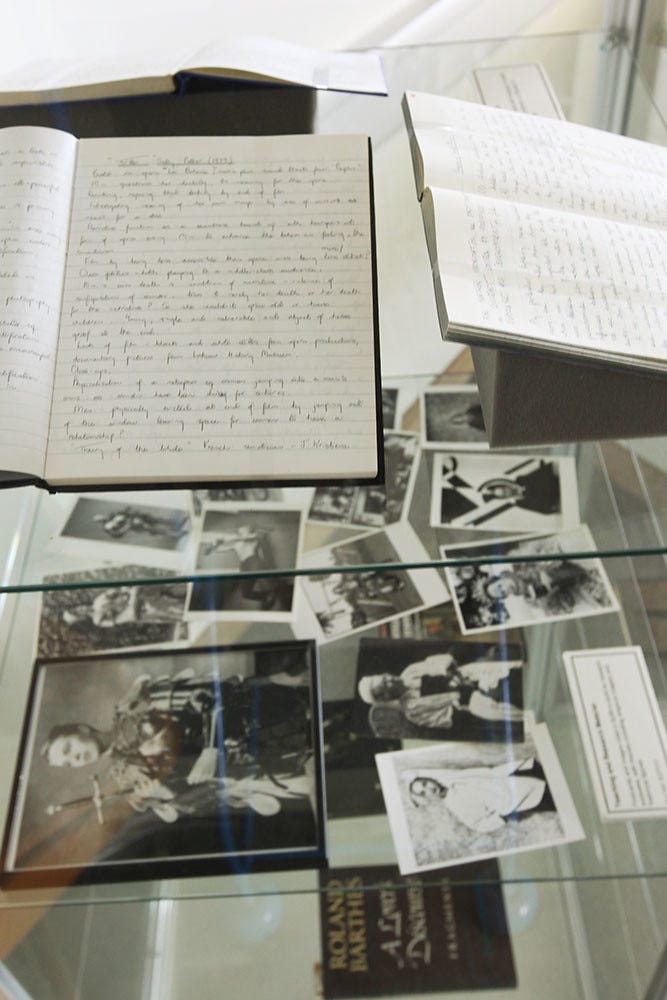
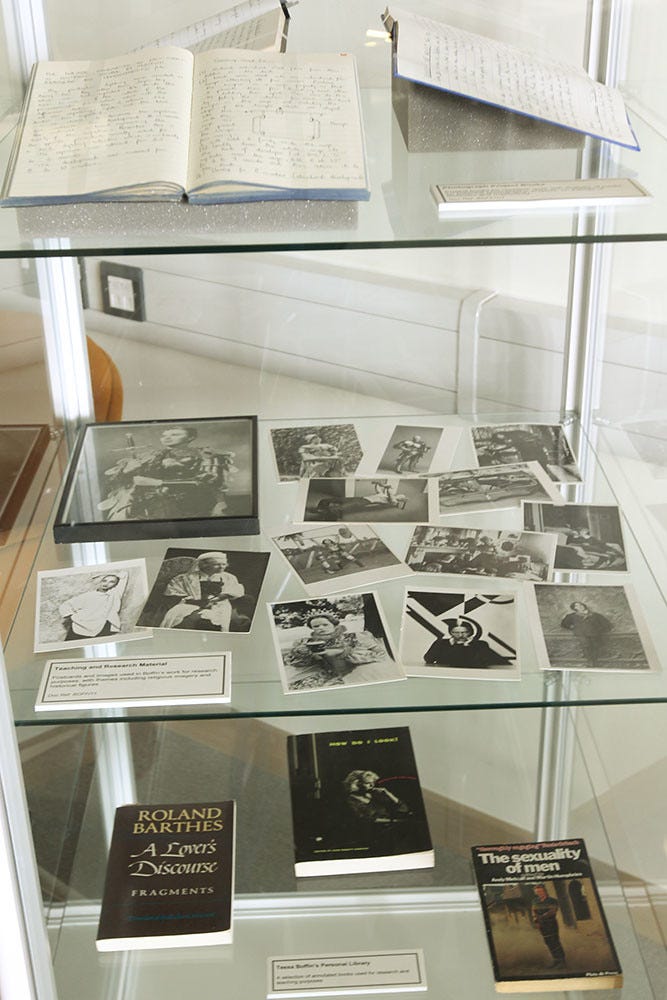
Boffin’s educational background also connected her to a community of politically engaged photographers and artists who were using their work to address social issues and challenge cultural conventions. The Polytechnic of Central London had a reputation for producing photographers interested in documentary and social commentary, but it also supported more experimental and conceptual approaches. Through her studies and her involvement in London’s alternative art scenes, Tessa encountered the work of photographers like Jo Spence, who used photography to explore illness, identity, and working-class experience, and Sunil Gupta, who documented gay life and would later become one of Boffin’s key collaborators. These connections and influences helped shape Boffin’s understanding of photography not as a neutral recording device but as a powerful tool for political intervention and cultural transformation. Her education gave her the technical expertise to realize her ambitious staged photographs while her theoretical training provided the conceptual frameworks that made her work so intellectually sophisticated.

Artistic Influences and Style
Key Influences
The artistic lineage Tessa Boffin positioned herself within extended from early twentieth-century avant-garde movements through contemporary activist art practices. The surrealists’ interest in dreams, fantasy, and the unconscious found clear echoes in Boffin’s approach to photography as a tool for imagining alternative realities. She particularly admired how surrealist photographers like Claude Cahun and Dora Maar used the camera to explore identity as something fluid and constructed rather than fixed and natural. These early twentieth-century artists provided models for how photography could be used not to document the world as it is but to envision the world as it might be, a crucial insight for Boffin, who understood that marginalized communities need images of possibility as much as they need images of reality. The surrealists’ embrace of the uncanny, the sexual, and the transgressive also aligned with Tessa’s own interests in representing lesbian desire in ways that challenged both mainstream culture’s prudishness and some feminist movements’ discomfort with explicit sexuality.
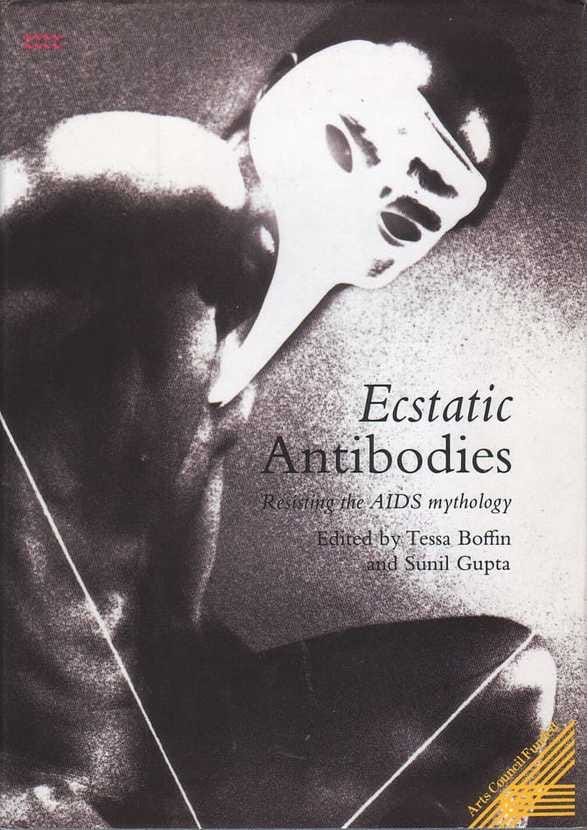
Contemporary art and political movements of the 1980s and early 1990s also profoundly influenced her work. She was working during the height of the AIDS crisis, when activist art collectives like Gran Fury and artists like David Wojnarowicz were creating urgent, confrontational work that insisted on the visibility and humanity of people living with HIV. This activist art demonstrated how images could be powerful tools for political intervention, not just aesthetic contemplation. Boffin shared this understanding of art as activism, creating work that wasn’t meant simply to hang in galleries but to circulate within communities, spark conversations, and potentially change hearts and minds about lesbian identity and sexuality. Her involvement in curating exhibitions like Ecstatic Antibodies alongside Sunil Gupta connected her to broader networks of politically engaged photographers and artists who were using their work to respond to the AIDS crisis.
British cultural traditions also shaped Tessa’s aesthetic sensibility, particularly the tradition of working-class camp and theatrical performance that characterized much of London’s queer nightlife. The drag queens, club kids, and performance artists who populated spaces like the clubs where Boffin performed brought a distinctly British sensibility to queer culture, one that emphasized wit, irony, and a certain dark humor in the face of social marginalization and political hostility. This influence appears in Boffin’s work through her deadpan humor, her embrace of camp aesthetics (evident in works like The Sailor and the Showgirl), and her willingness to mix high and low cultural references. Her photographs often feature elements of both classical art and pulp pornography, academic theory and street slang, revealing an artistic sensibility that refused to respect boundaries between legitimate and illegitimate culture. A refusal that itself was a political statement about who gets to be taken seriously as an artist and intellectual.
Art + Identity
For Tessa Boffin, art and identity were fundamentally inseparable. Her photographic practice was a means of exploring, constructing, and asserting her own complex identity as a queer woman while simultaneously creating representations that other lesbian women could see themselves in. This understanding of art as identity work was rooted in Boffin’s theoretical training and her lived experience as someone who often felt invisible in mainstream culture and marginalized even within LGBTQIA2S+ spaces. In a 1991 radio interview, Boffin explained that she was trying to put lesbians back on the political agenda, addressing how lesbian women had been systematically excluded from both AIDS awareness campaigns and broader cultural conversations about sexuality and desire. Her art became a tool for insisting on lesbian presence and visibility, creating images that couldn’t be ignored or dismissed.
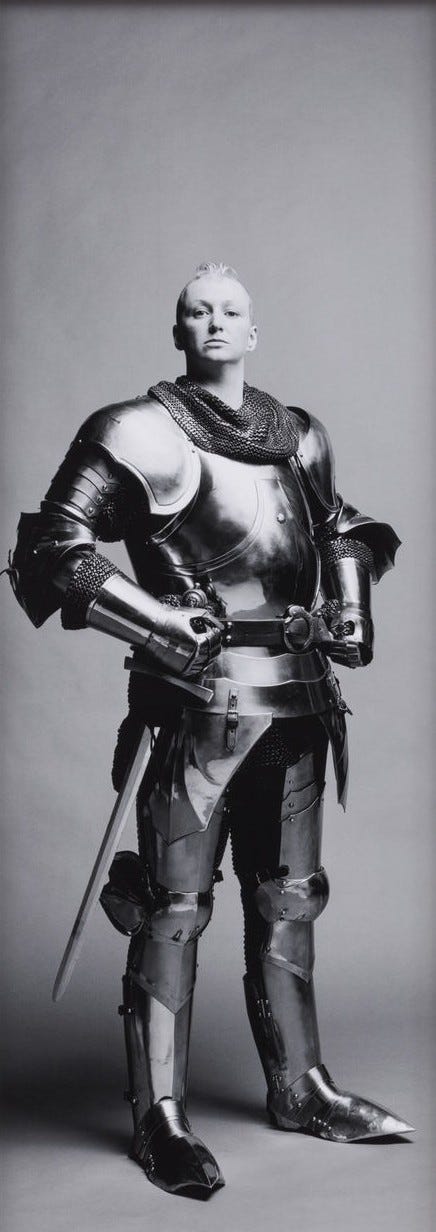
Tessa’s approach to identity in her work was sophisticated and nuanced. Rather than presenting identity as something fixed and stable, her photographs explored identity as performative and constructed, something that people actively create through how they present themselves, what roles they adopt, and what communities they belong to. This is evident in how she used costume, props, and theatrical staging to create her images. In The Knight’s Move, for example, Boffin and her collaborators don’t simply document existing lesbian identities but actively create new ones, adopting roles like The Knight, The Knave, and The Casanova that traditionally belonged to heterosexual romantic narratives. By placing queer women in these roles, Tessa was both claiming these narratives for lesbian desire and demonstrating how identity is something we construct through imagination and fantasy as much as through lived experience.
The relationship between Boffin’s personal identity exploration and her artistic practice was also evident in how she questioned gender categories toward the end of her life. Cherry Smyth’s description of Boffin as a “crisis of category” suggests someone who refused to be contained by conventional labels and categories. This fluid approach to identity appears throughout her work, from her embrace of masculine and feminine aesthetics in her photographs to her interest in BDSM culture’s exploration of power dynamics and role-play. For Boffin, identity wasn’t something to be pinned down definitively but rather something to be explored, experimented with, and performed in different ways in different contexts. Her art provided a space for this exploration, allowing her to try on different identities and imagine different ways of being in the world, a practice she hoped would resonate with other queer women navigating their own complex relationships to identity, desire, and community.
Art + Activism
Tessa Boffin’s commitment to activism was inseparable from her artistic practice, and she understood her photographs as interventions in urgent political struggles facing lesbian and gay communities in the 1980s and early 1990s. Her work consistently addressed specific political issues and challenges, from the exclusion of lesbians from AIDS awareness campaigns to the lack of visual representation of lesbian desire and debates within feminist and queer communities about sexuality and representation. But rather than creating propaganda or didactic messaging, Boffin’s activist art worked through sophisticated visual strategies that engaged viewers aesthetically and emotionally while also making clear political arguments. Her photographs were beautiful, thought-provoking, and often humorous even as they tackled serious issues of life, death, sexuality, and identity.
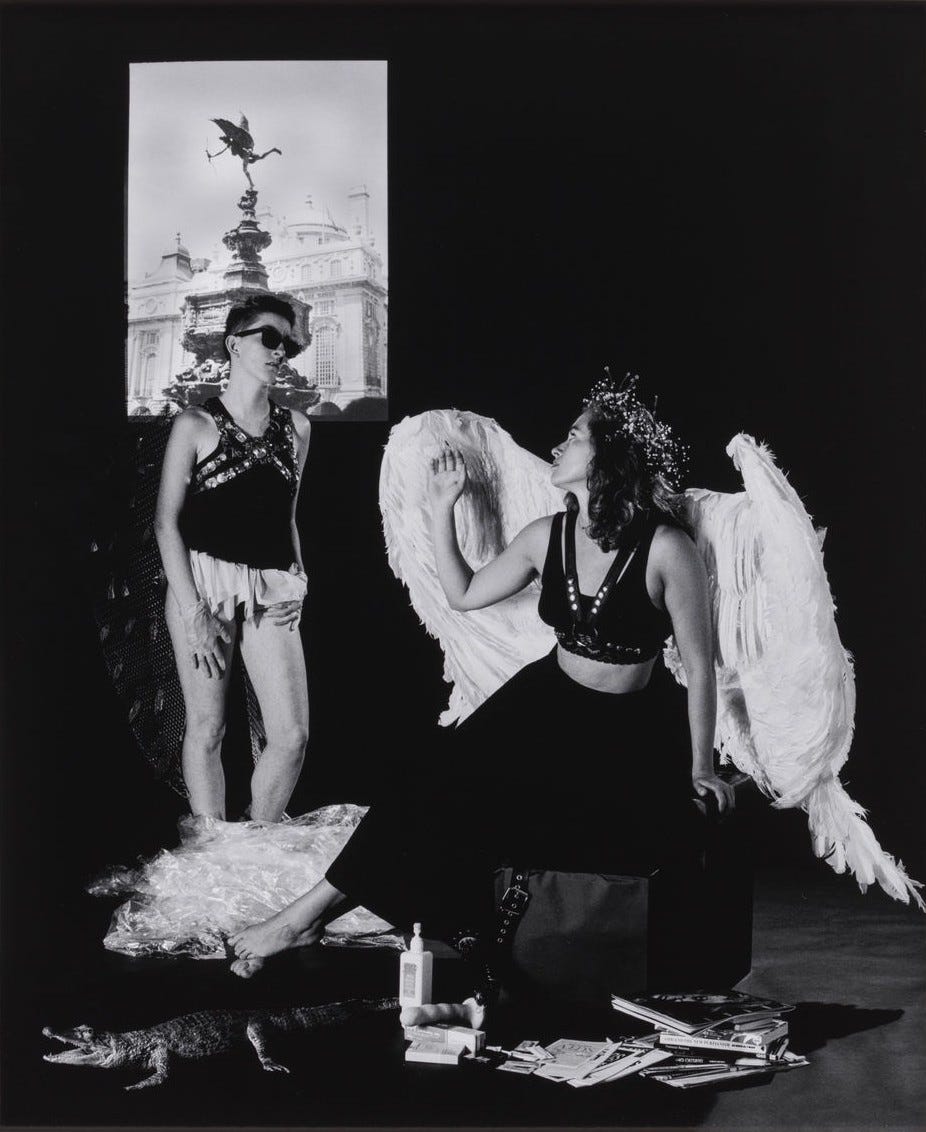
Angelic Rebels: Lesbians and Safer Sex exemplifies Tessa’s approach to activist art. Created in 1989 at the height of the AIDS crisis, the series directly addressed the dangerous exclusion of women, particularly lesbians, from safe sex education and AIDS awareness efforts. Mainstream AIDS campaigns focused exclusively on gay men, while lesbians were often told they were at no risk, a message that left women vulnerable and perpetuated the erasure of lesbian sexuality from public discourse. Boffin’s series insisted on lesbian presence in conversations about AIDS while also promoting safer sex practices, using the visual language of fantasy and surrealism to create images that were both informative and erotically engaging. The series showed that safer sex didn't have to mean boring sex, the angels engaging in intimacy with latex gloves demonstrated that protection could be integrated into sexual fantasy and desire.
“Lesbians have remained virtually invisible in the crisis AIDS has engendered in representation. Government safer sex campaigns have failed to address us along with gay men, black people, prostitutes, bisexuals, and other communities who are seen as ‘disposable’. Scientists have ignored our very existence, neglecting to ask us what we do in bed because lesbian transmission of HIV infection has been ruled out, even before being investigated. Certain sections of the lesbian community have given themselves a pat on their lesbian separatist backs and callously distanced themselves from all AIDS work. Such women see us as nun-like in that we are an exclusive community that does count ex-heterosexuals, bisexuals, IV-drug users or prostitutes amongst its members. These women also regard us as virgin angels, immune to infection by virtue of the fact that lesbian sex is somehow seen as purer, cleaner and safer than any other form of sexual practice. This view fails to acknowledge there are certain activities: rimming, fisting, cunnilingus, and so on, which cut across the fragilic boundaries of sexual orientation, and could put anyone, regardless of their sexuality or gender, at risk.”
— Tessa Boffin in Ecstatic Antibodies: Resisting the AIDS Mythology
Beyond her individual artistic practice, Boffin was also deeply involved in organizing exhibitions and creating platforms for other queer photographers. Her co-curation of Ecstatic Antibodies: Resisting the AIDS Mythology with Sunil Gupta in 1990 brought together photographers responding to the AIDS crisis, and the accompanying book became an important resource for understanding how images both reinforced and resisted dominant narratives about AIDS. Similarly, Stolen Glances: Lesbians Take Photographs, co-curated with Jean Fraser in 1991, was a landmark exhibition that showcased lesbian photographers from around the world and included an influential book that remains a key text in lesbian visual studies. Through both her own work and her curatorial projects, Tessa was building infrastructure for queer visual culture: creating archives, making connections between artists, and ensuring that the photographic work being created in response to the AIDS crisis and in service of lesbian visibility would be preserved and valued. This organizational and curatorial work was itself a form of activism, recognizing that creating individual artworks isn’t enough; communities also need institutions, archives, and networks to sustain cultural production over time.



Significant Works
The Sailor and the Showgirl, 1993
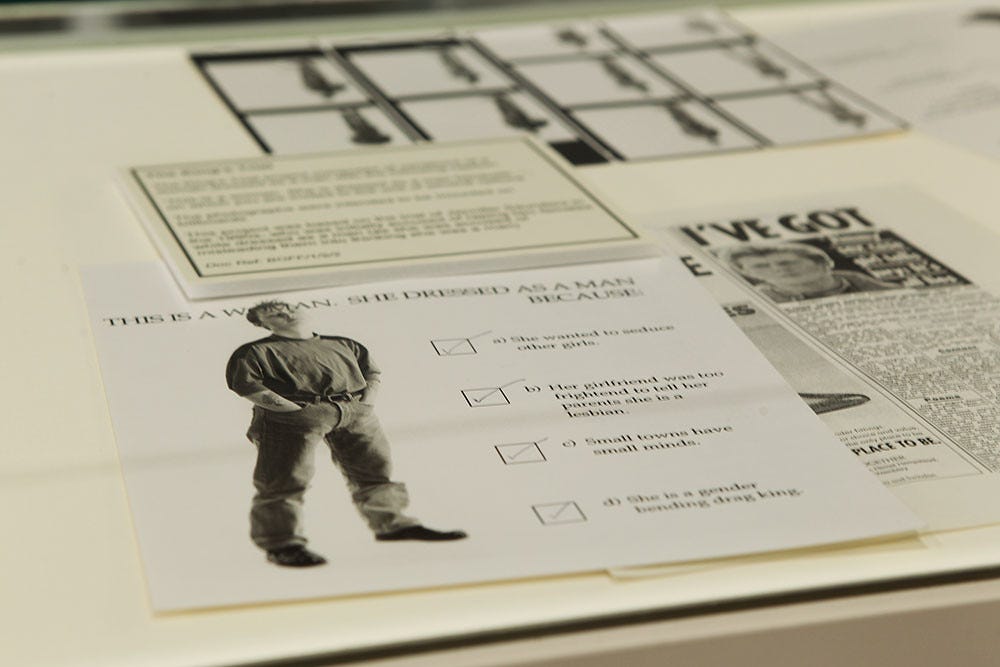
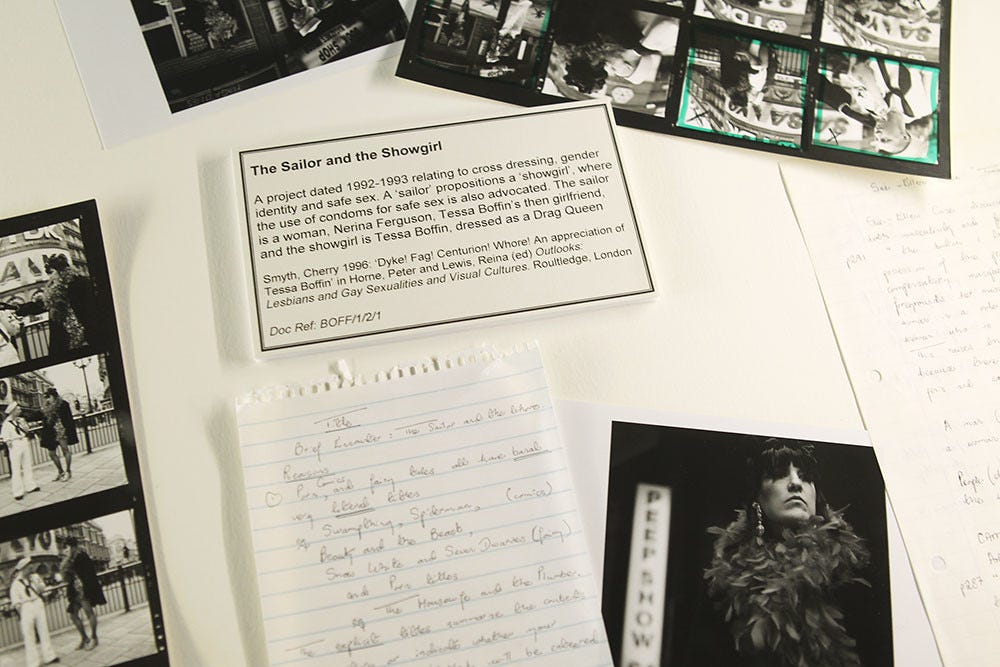
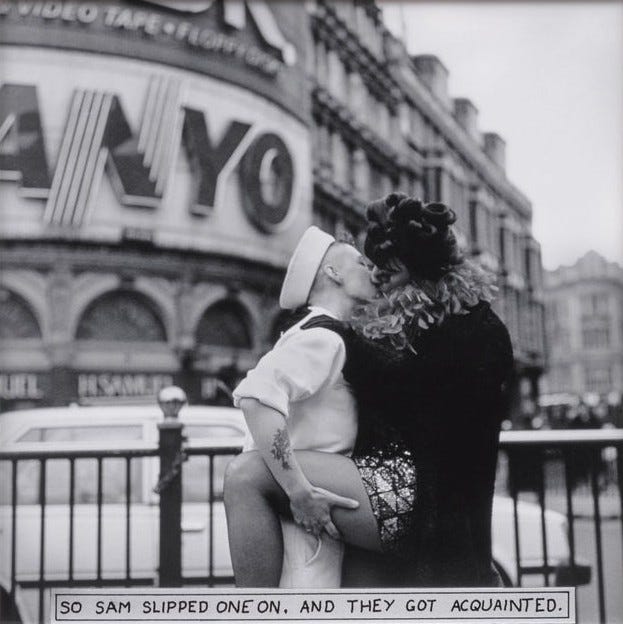
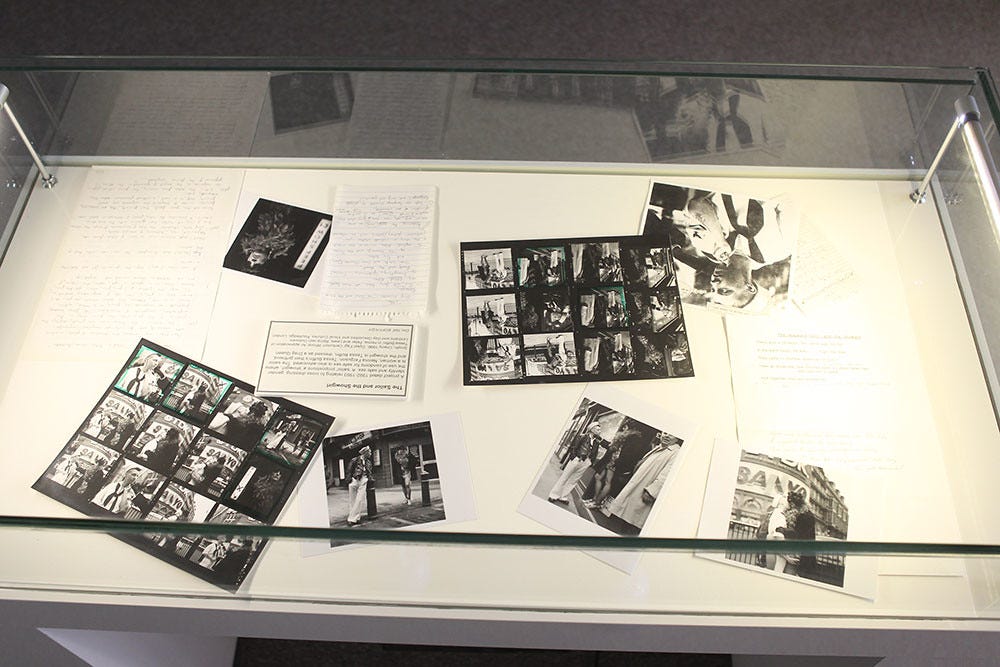
The Sailor and the Showgirl (1993) represents Tessa Boffin’s final major work and demonstrates a significant departure from her earlier series in both form and tone. Created as a four-frame photo comic strip for the exhibition Positive Lives: The Response to HIV at the Photographers Gallery in London, the series shows Boffin’s willingness to experiment with new formats and embrace popular culture forms like comics as vehicles for activist messaging. The work was created in collaboration with Boffin’s then-girlfriend Nerina Ferguson, who plays the sailor character, and Denis Doran, bringing an explicitly collaborative dimension to the project that contrasts with Boffin’s more solitary creation of her earlier series. The comic strip format allowed Boffin to integrate text and image in new ways, using speech bubbles with street language and explicit sexual references to create a narrative that was simultaneously educational about safer sex, celebratory of lesbian desire, and camp in its theatrical excess.
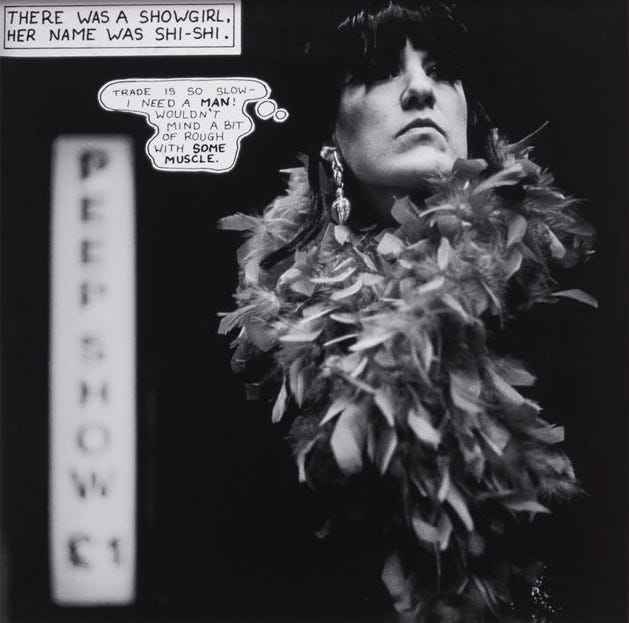
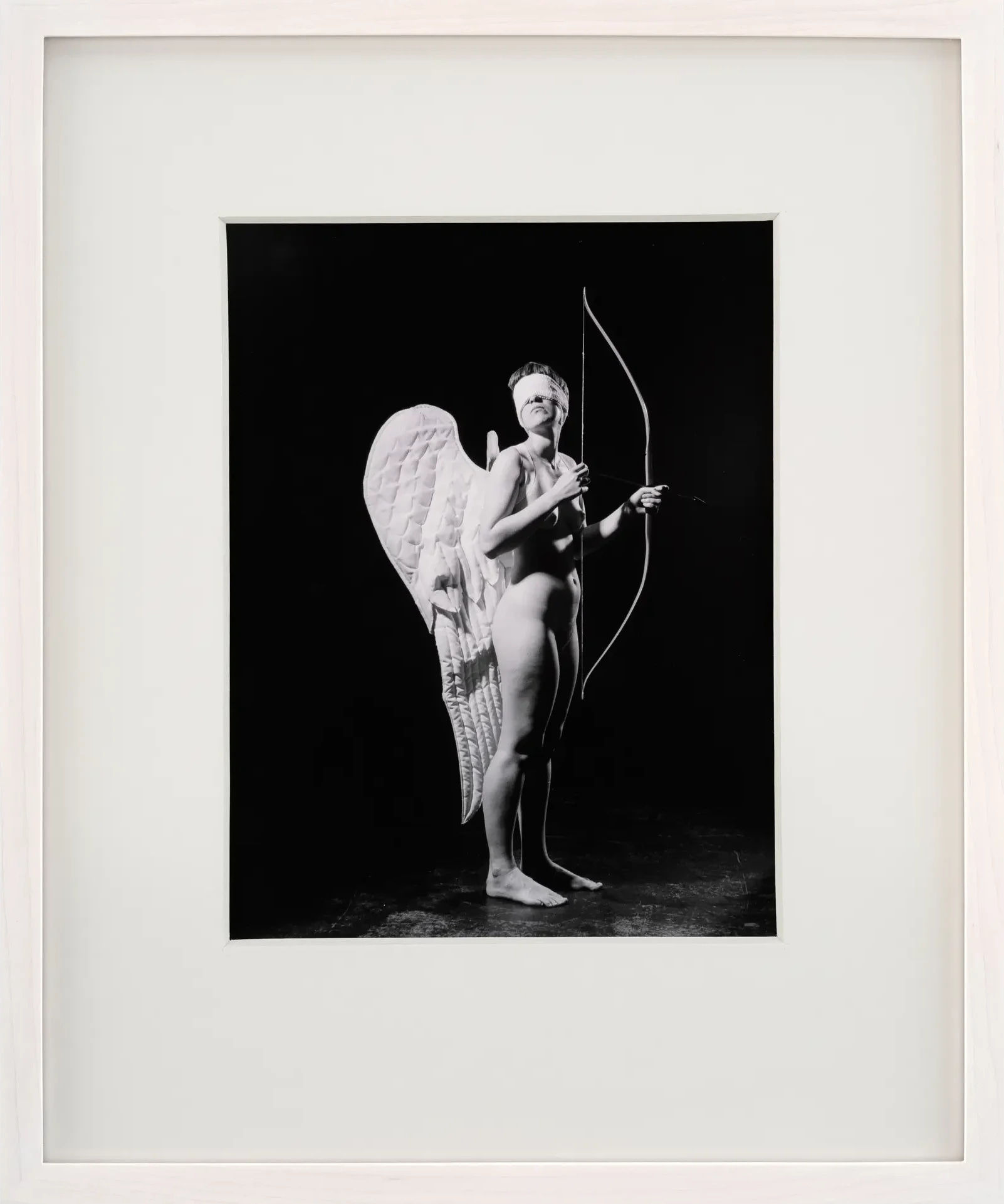
The series features Boffin as a showgirl, specifically a drag queen showgirl performing in London’s Soho, and Ferguson as a sailor on shore leave, playing with butch/femme dynamics and the theatrical possibilities of costume and role-play. This characterization connects to Tessa’s personal investment in drag performance and her ongoing exploration of gender presentation as creative practice rather than natural expression. By 1993, Boffin was actively questioning her own gender identity and exploring masculine presentation in ways that put her at odds with some members of London’s lesbian community. Her performance of the showgirl character: hyper-feminine, theatrical, explicitly performative, can be read as both an embrace of drag aesthetics and a commentary on femininity itself as a kind of drag, a set of learned behaviors and presentations rather than an essential identity. The sailor character, meanwhile, embodies a classic butch archetype, the masculine-presenting woman in uniform who desires feminine women, but the comic strip format and camp aesthetic ensure this is read as playful performance rather than earnest identity claim.
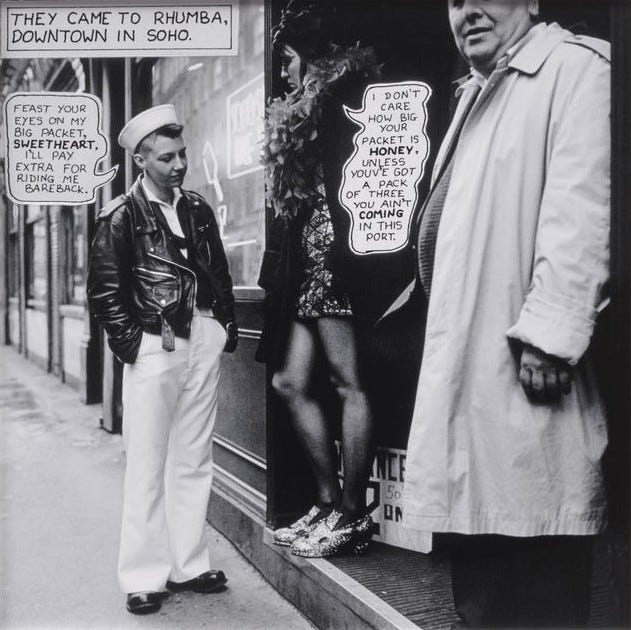
What distinguishes The Sailor and the Showgirl from Boffin’s earlier work is its lighter tone and more explicit humor. While Angelic Rebels and The Knight’s Move both contain elements of wit and irony, they address their political concerns, AIDS awareness, lesbian historical erasure, with a certain gravity appropriate to the seriousness of their subjects. The Sailor and the Showgirl, by contrast, approaches safer sex education through comedy, camp, and sexual explicitness that seems designed to entertain as much as educate. The narrative follows a classic seduction scenario: sailor meets showgirl, attraction develops, sexual encounter ensues, but crucially, safer sex practices are integrated into the encounter. By 1993, safer sex messaging had become more established within LGBTQIA2S+ communities, and Tessa could assume a baseline of knowledge about HIV transmission and prevention that allowed her to create work that reinforced rather than introduced these concepts. The comic strip format, with its association with popular entertainment rather than high art, also signaled that AIDS education didn’t have to be solemn or frightening to be effective.
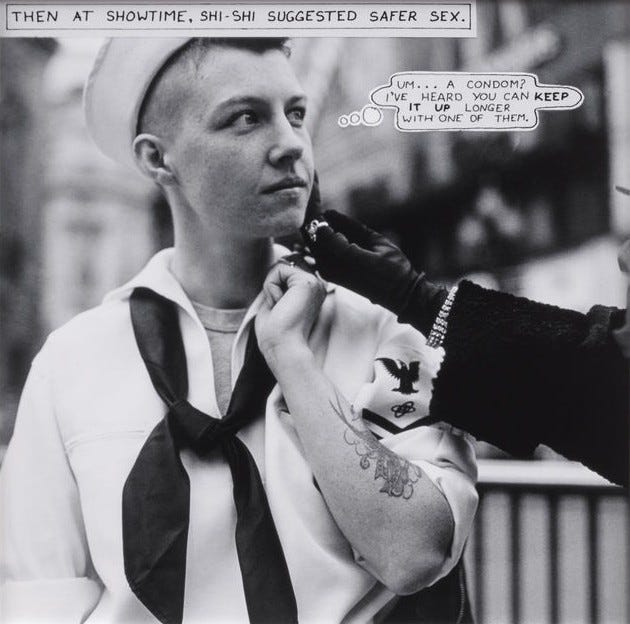
The significance of The Sailor and the Showgirl lies partly in its timing as Boffin’s final work, created in what would be the last year of her life. The series demonstrates that even as Boffin faced personal struggles like difficulties finding employment, questioning her gender identity, experiencing violence and rejection even within queer spaces, she remained committed to creating work that affirmed lesbian desire and promoted community health. The playful, celebratory quality of the piece suggests an artist who could still find joy and humor despite increasingly difficult circumstances. Looking at the work today, knowing what we know about Tessa’s death later that same year, adds a layer of poignancy to its exuberant celebration of queer sexuality and survival. The series also represents an important example of how AIDS activist art evolved over the course of the epidemic; by 1993, artists were finding new ways to address safer sex that moved beyond the urgency and sometimes grim tone of earlier AIDS awareness work toward approaches that centered pleasure, humor, and community joy. The Sailor and the Showgirl reminds contemporary audiences that even in the darkest moments of crisis, queer communities have found ways to celebrate, to laugh, to affirm life and desire.
The Knight’s Move, 1990
The Knight’s Move (1990) represents Tessa Boffin’s most ambitious exploration of how fantasy and imagination can serve as tools for identity formation within marginalized communities. Created specifically for the groundbreaking exhibition and book Stolen Glances: Lesbians Take Photographs, which Boffin co-curated with Jean Fraser in 1991, the series directly addresses the scarcity of lesbian representation in historical archives and the challenge of constructing identity when you cannot find yourself reflected in the past. The work’s title references both the chess piece’s distinctive L-shaped movement and Tessa’s conceptualization of how queer people might move “sideways” or laterally into established cultural narratives that were never designed to include them. This strategic, oblique approach to claiming space within heterosexual romantic traditions reflects Boffin’s sophisticated understanding of how marginalized groups must often work indirectly, appropriating and transforming dominant cultural forms rather than waiting for permission to participate in them.
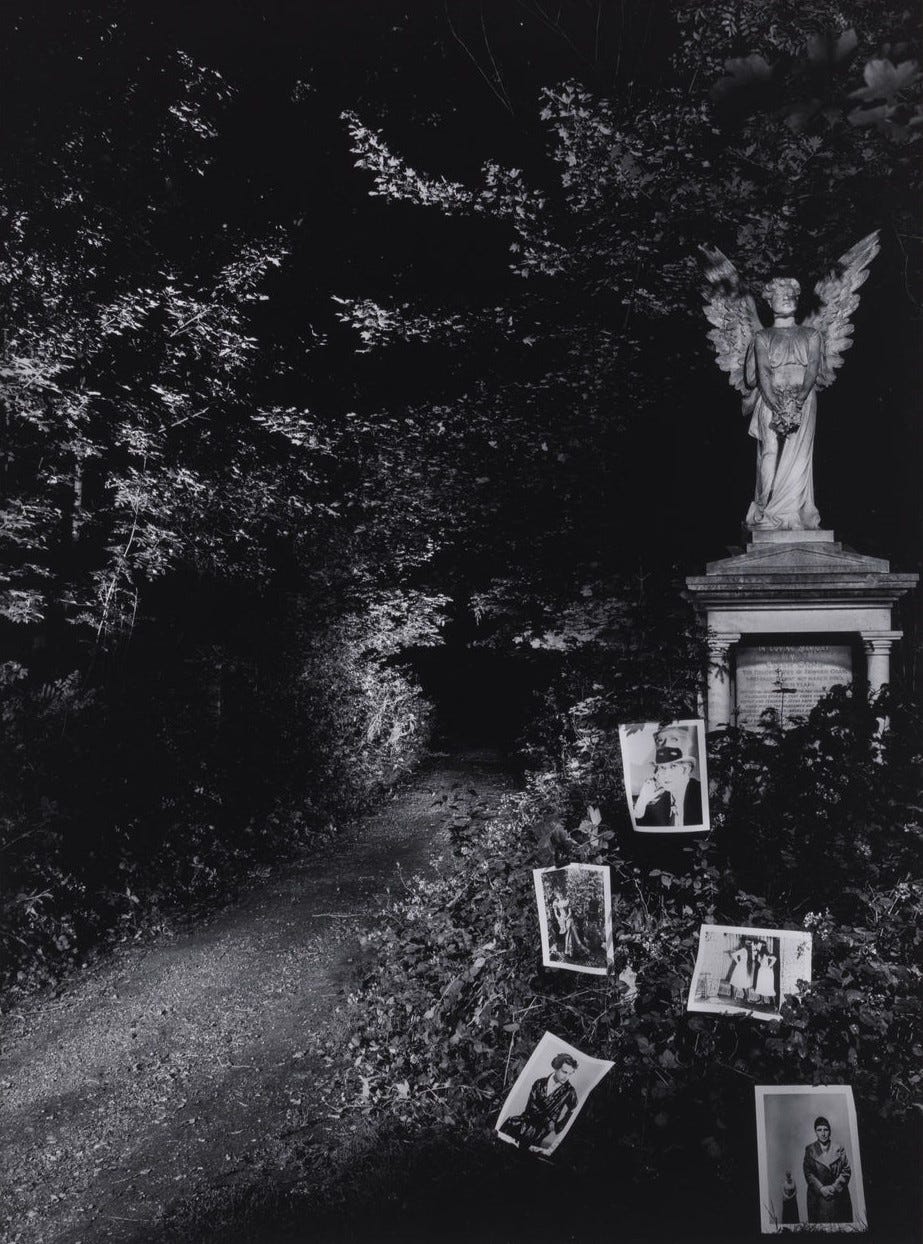
The series opens with one of Boffin’s most haunting images: a cemetery scene with scattered photographs of historical lesbian figures lying among the graves and brush. These are portraits of known lesbians like Gertrude Stein photographed by Cecil Beaton, Janet Flanner and Sylvia Beach captured by Berenice Abbott, and Alice Austen’s self-portraits. The image is both an acknowledgment of real lesbian existence in history and a meditation on absence and erasure. These women existed, were photographed, left traces of their lives and loves, yet their stories remain scattered, fragmentary, difficult to access. The cemetery setting suggests both death and preservation, these figures are gone, but their images persist, waiting to be recovered and claimed by contemporary lesbian women seeking their own history. This opening photograph establishes the series’ central concern: what do you do when your history is so fragmentary and scattered that you can barely piece together a coherent narrative of who came before you?
“My starting point for The Knight’s Move was the intense frustration I feel when people prioritise reality - everyday experience, ‘real’ sex and so on - over and above fantasies. Staged ‘scenes’ and photo-tableaux are all seen as second best since they are always self-consciously (and even unconsciously) constructed and played out. Photography, with its supposedly intimate connection with reality, is inevitable viewed as a documentation of the ‘Real’, never (heaven forbid) as a fantasy. I wanted to throw this equation into question by looking at how our identities as dykes are constructed through historical role models, both in fact and in fantasy.
…
Yet we need to acknowledge that the stakes are remarkably high because of the relative paucity of lesbian imagery. There are so few representations and so many unfulfilled desires. The burdens imposed by this scarcity of representations can, however, be overcome if we go beyond our impoverished archives to create new icons. One way we can move forward is by embracing our idealised fantasy figures, by placing ourselves into the great heterosexual narratives of courtly and romantic love: by making The Knight’s Move - a lateral or sideways leap.”
— Tessa Boffin and Jean Fraser in Stolen Glances: Lesbians Take Photographs


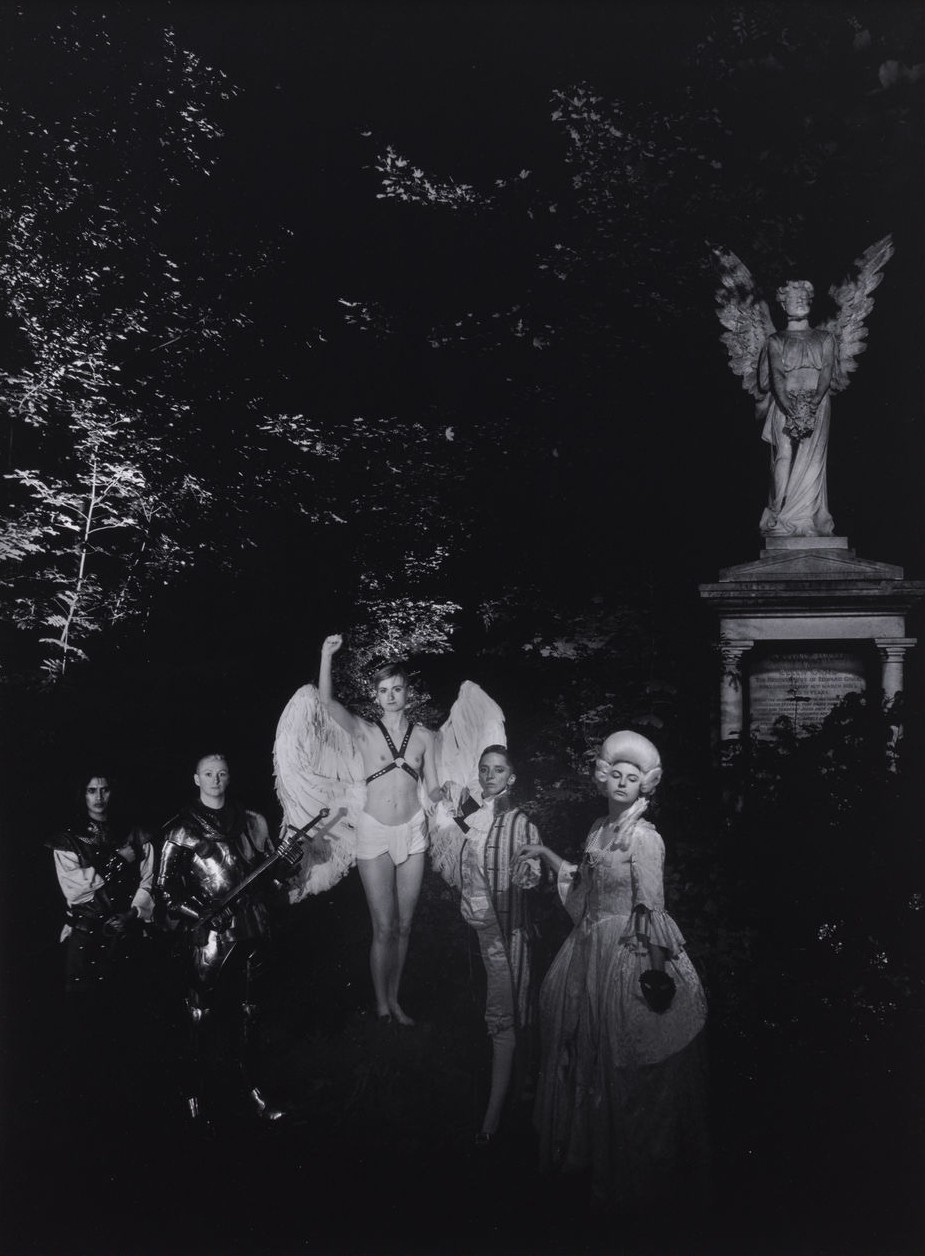
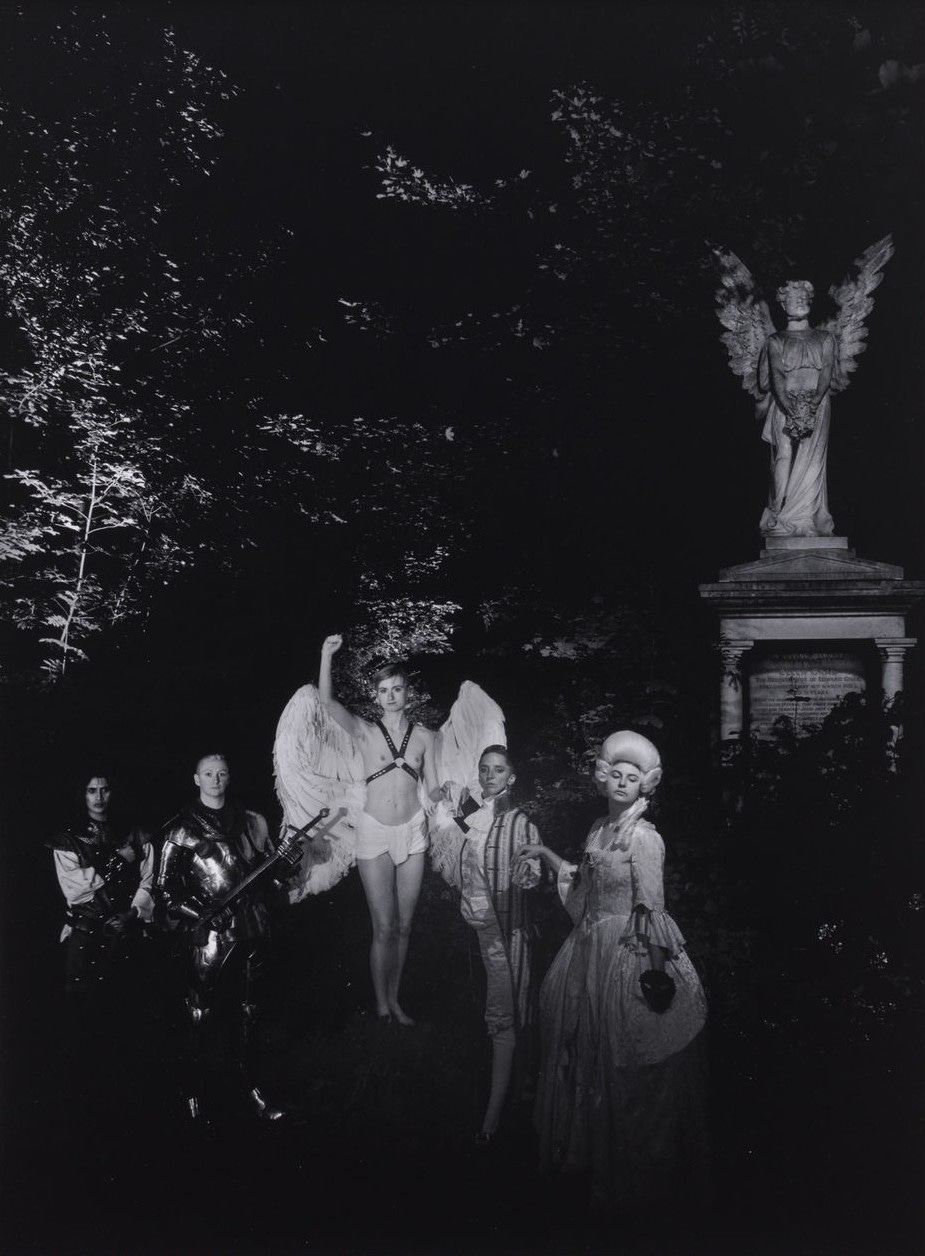
Boffin’s answer unfolds across the subsequent photographs, which introduce five fantasy figures drawn from romantic and chivalric literature: the Knight, the Knave, the Angel, the Casanova, and the Lady-in-Waiting. These characters traditionally belong to heterosexual narratives of courtly love and romantic conquest, but Boffin reimagines them as lesbian archetypes through elaborate costuming, theatrical staging, and same-sex desire. Each figure is photographed individually in dramatic poses that emphasize both their historical reference points and their contemporary queer reinterpretation. The Knight appears in armor and masculine dress, the Casanova in rakish period costume, the Lady-in-Waiting in feminine finery, but all are played by women, all exist within a lesbian erotic framework, all claim space within romantic narratives that historically excluded them. The accompanying text makes this appropriation explicit: “WHERE IS MY KNIGHT / MY KNAVE / MY ANGEL / MY CASANOVA / MY LADY-IN-WAITING? / I COULD HARDLY FIND YOU / IN MY HISTORY BOOKS / BUT NOW IN THIS SCENE / YOU ALL COME TOGETHER.” The text acknowledges the absence of these figures from conventional historical records while simultaneously creating them through photographic fantasy.


The series concludes with a triumphant return to the cemetery, but now instead of scattered photographs, the five reimagined figures themselves stand assembled, with the angel at the center, fist raised in a gesture of victory and defiance. This transformation from fragmented historical traces to fully realized fantasy figures represents Boffin’s argument about imagination’s crucial role in queer identity formation. When history fails to provide adequate role models or narratives, imagination must fill the gap. The significance of The Knight’s Move both at the time of its creation and today lies in this insistence that marginalized communities have the right to create their own mythologies, their own heroes, their own histories. In 1990, when lesbian representation remained scarce in both mainstream culture and historical archives, Tessa’s creation of alternative icons provided desperately needed images that lesbian women could use for inspiration and identification. The series appeared in Stolen Glances alongside work by other lesbian photographers, creating a collective archive of lesbian visual culture that challenged the notion that such culture didn’t exist or wasn’t worth documenting. Today, as debates continue about whose histories get told and preserved, The Knight’s Move remains powerfully relevant, reminding us that creating new narratives and claiming space within old ones are both legitimate and necessary strategies for communities whose stories have been systematically erased.
“For subcultures such as lesbians’ that are consistently unrepresented then, the notion of roles models is both essential, and simultaneously restrictive. Essential in that it is necessary for representations of our communities to be both visible to us, and acknowledged by the ‘general public,’ of which we are also a part. Restrictive in that we as a marginalised group have so few historical lesbian images upon which to model our psychic or social selves.
If we persist in prioritising reality - actual historical role models at the expense of fantasy figures - we leave our sense of selves and our imagery wanting, and certain questions unasked. For example, who mobilises our desires and fantasies, given that they cut across the fragile boundaries of sexual identity and gender; and which archetypes do our desires attach themselves to? Are these dramatis personae the same as the real life historical role models? Somewhere within this tension, this gap between reality and fantasy, we model ourselves on old tattered photographs and hazy daydreams.”
— Tessa Boffin and Jean Fraser in Stolen Glances: Lesbians Take Photographs
Angelic Rebels: Lesbians and Safer Sex Series, 1989
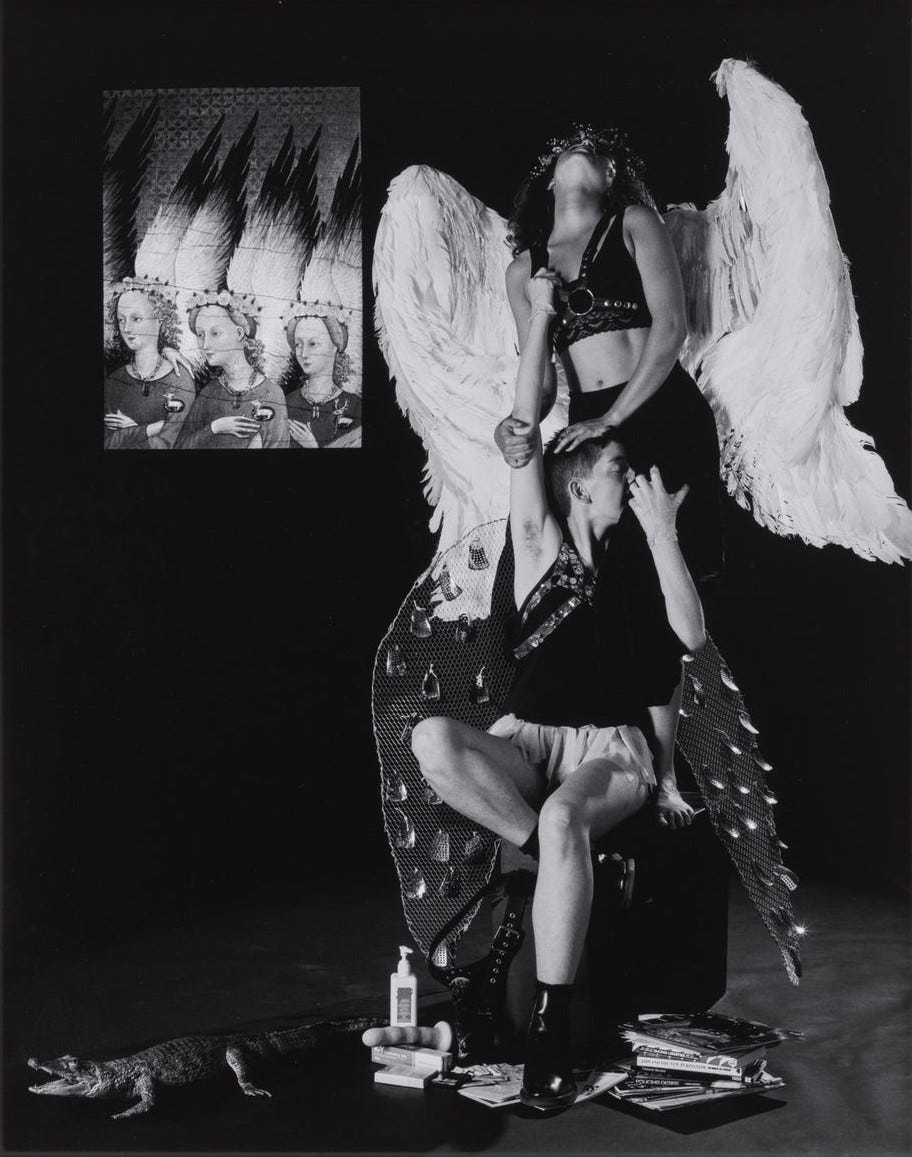
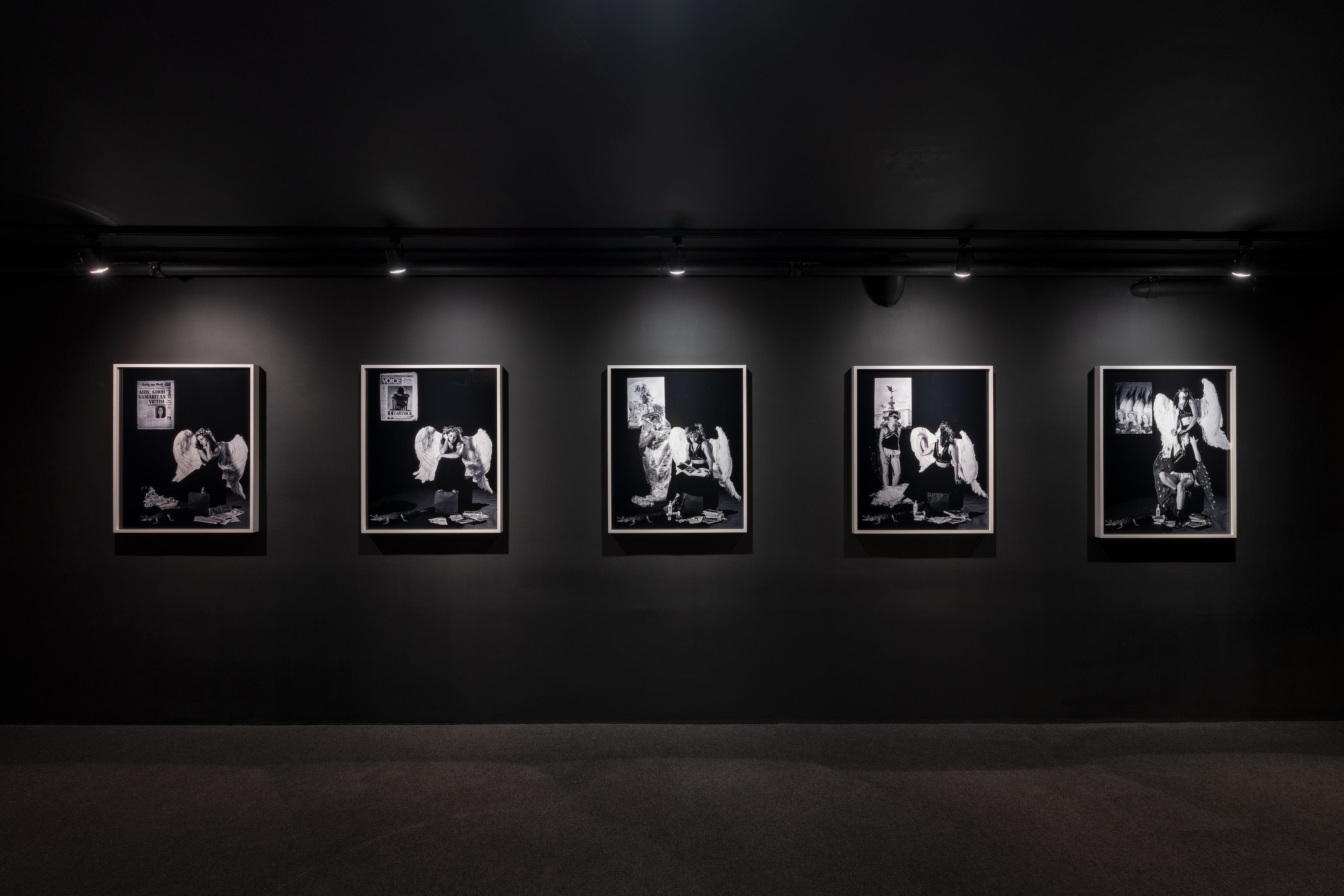
The Angelic Rebels: Lesbians and Safer Sex series stands as one of Tessa Boffin’s most politically urgent and artistically sophisticated works, created in 1989 when the AIDS crisis was ravaging LGBTQIA2S+ communities and the systematic exclusion of women from public health campaigns was reaching dangerous levels. The five-photograph series represents a direct intervention into the deadly silence surrounding lesbian sexuality and HIV transmission, challenging the pervasive myth that lesbians were immune to AIDS. At a time when safer sex education focused almost exclusively on gay men and when many public health officials dismissed the possibility that women could transmit HIV to each other, Boffin’s series insisted that lesbian sexual practices required the same thoughtful attention to safer sex as any other form of intimacy. By staging scenes that showed lesbian women engaging in intimacy while using latex gloves, Tessa created images that were simultaneously educational, erotic, and politically defiant. The series rejected the false choice between safety and pleasure, demonstrating that protective barriers could be integrated into sexual fantasy and desire rather than diminishing them.
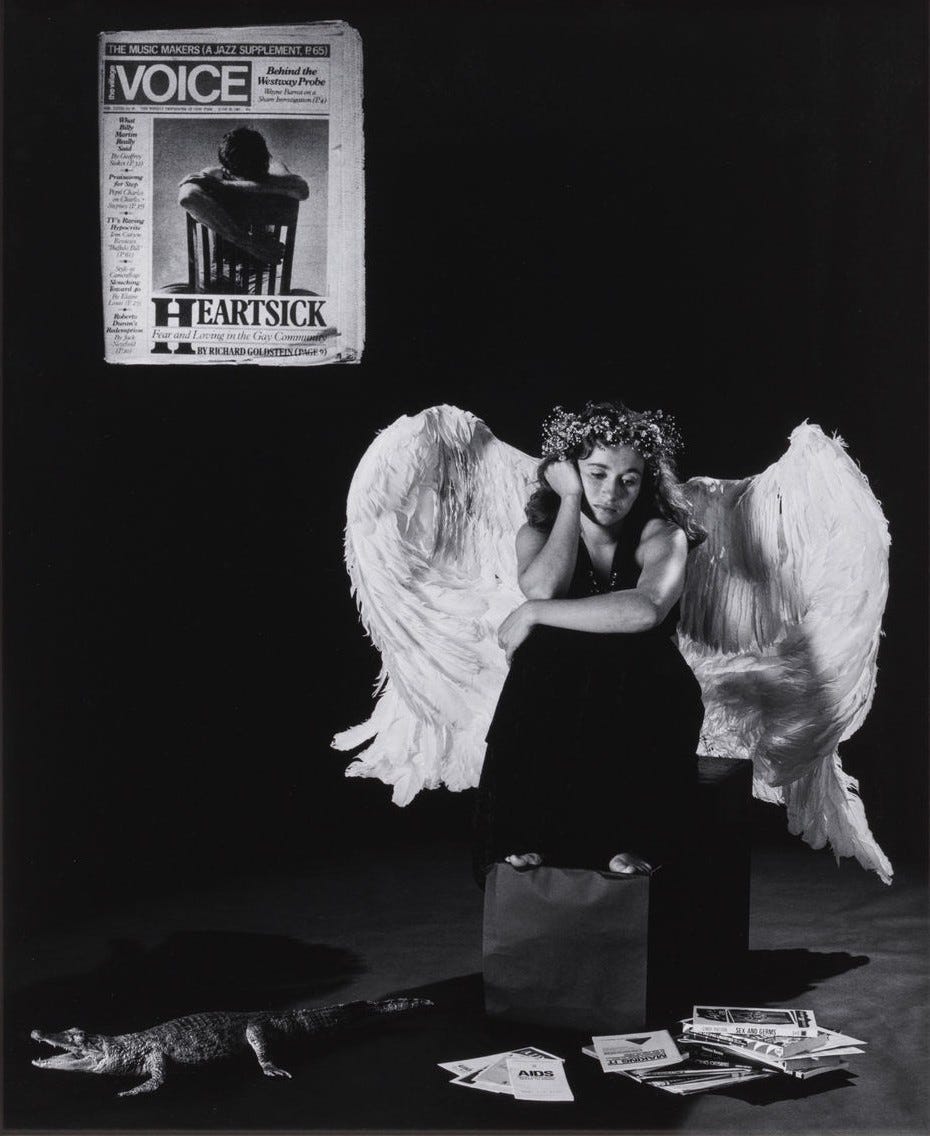
The visual and conceptual framework of Angelic Rebels demonstrates Boffin’s sophisticated engagement with art history and her ability to transform canonical references into queer narratives. The series directly appropriates Albrecht Dürer’s 1514 engraving Melencolia I, which depicts a winged angel surrounded by scientific instruments, appearing lost in melancholic contemplation.
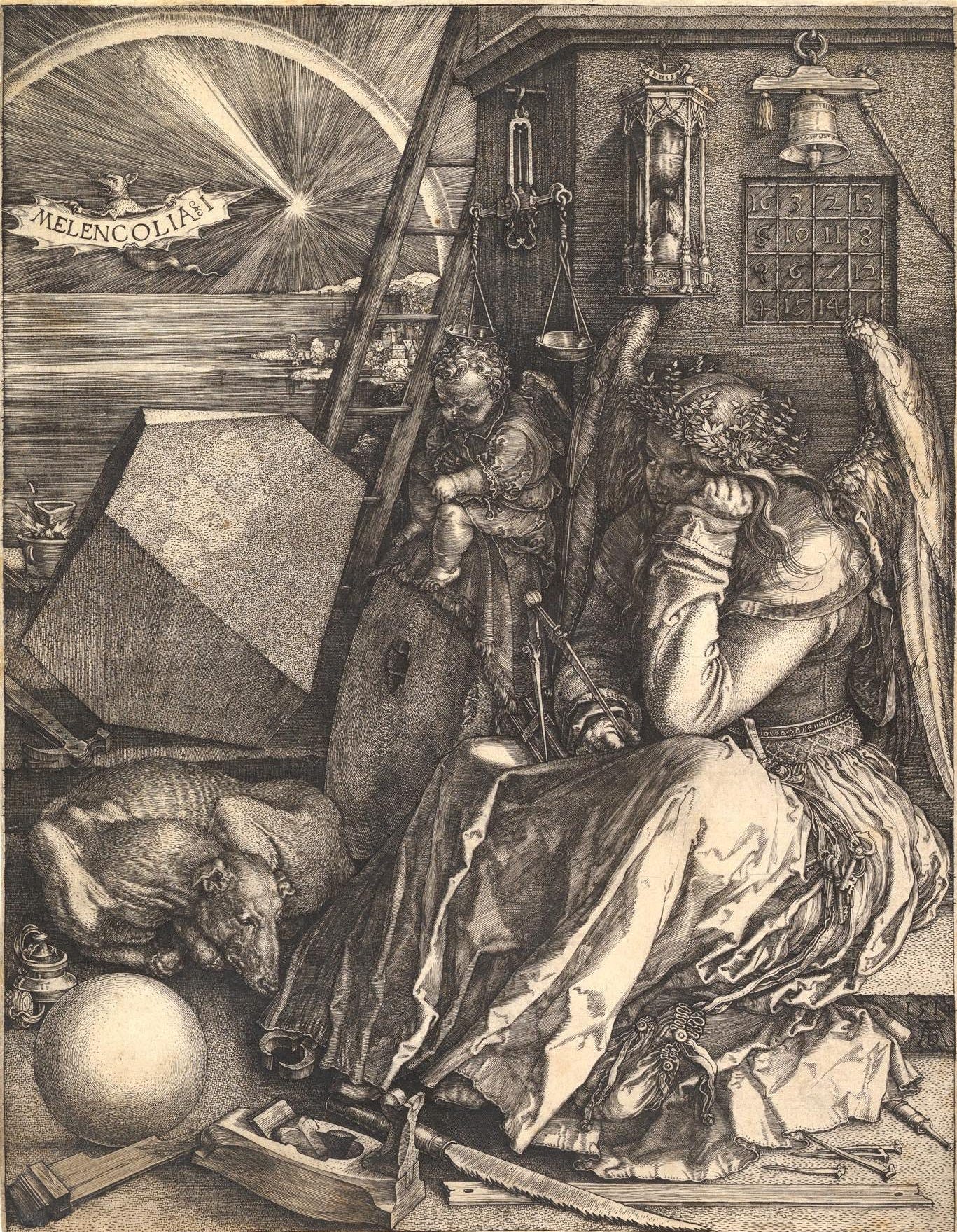
Tessa’s opening photograph recreates this composition with a leather-clad angel sitting in darkness, but the source of her melancholy is made explicitly contemporary and political, she’s surrounded by newspaper headlines about AIDS that exemplify the mainstream media’s sensationalist and often homophobic coverage. The angel has access to publications like the Daily Mail, which ran fear-mongering stories, and the Village Voice, which featured Peter Hujar’s photograph of David Wojnarowicz but still failed to address lesbian experiences of the epidemic. At the angel’s feet, however, are materials from gay and lesbian activist presses that provide more accurate, community-generated information about HIV transmission and safer sex practices. This setup establishes the series’ critique of how information circulates differently through mainstream versus community-based media, and how access to the right information can be transformative.


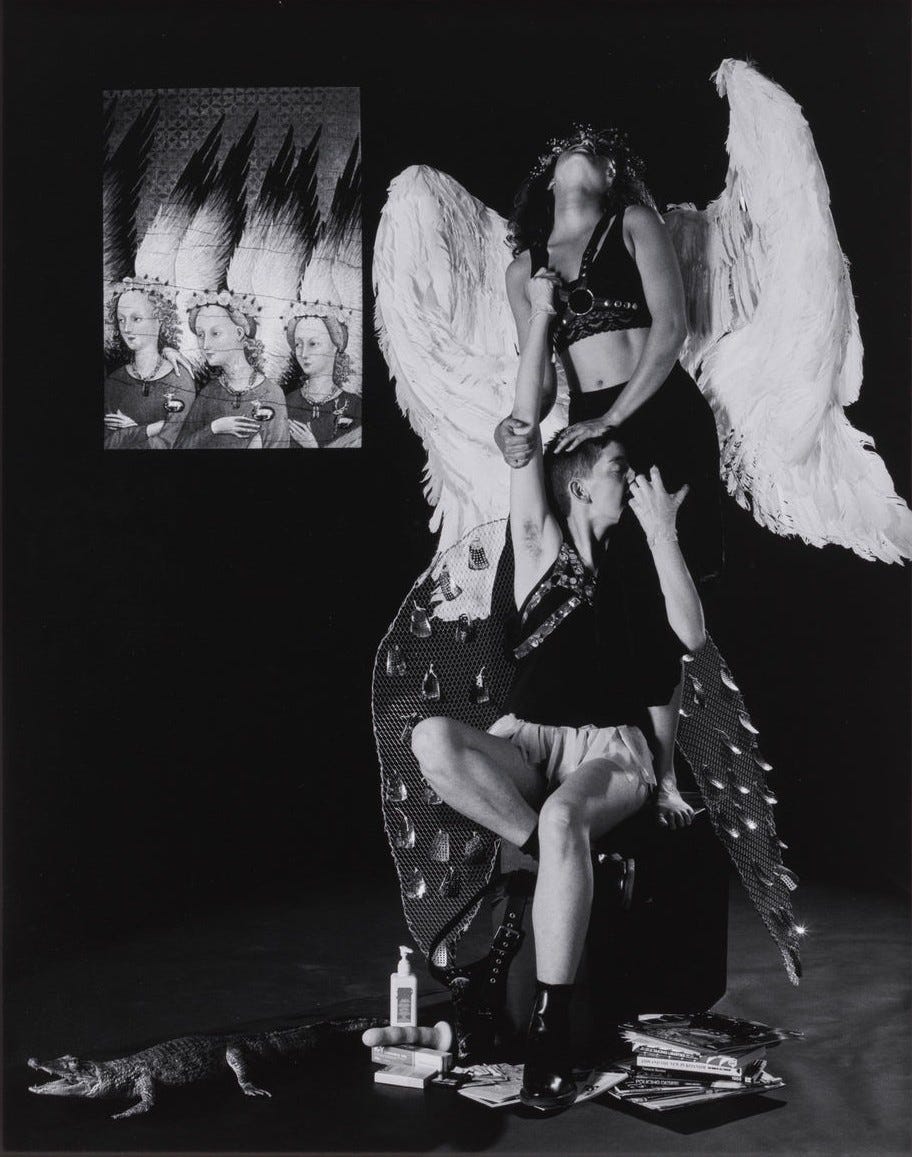
As the narrative unfolds across the five photographs, the angel’s discovery of accurate safer sex information becomes the catalyst for liberation and ecstasy. A second angel appears, wrapped dramatically in clingfilm, representing the safer sex practices that can protect lesbian women while still allowing for sexual pleasure and connection. The final photograph shows the original angel rising in ecstasy, still tethered by a leather harness but liberated from the melancholy that opened the series. This transformation from depression to ecstasy through knowledge and sexual pleasure makes a powerful argument about the connection between information, agency, and joy. The series suggests that proper education about safer sex doesn’t diminish desire but rather enables it, allowing lesbian women to pursue sexual pleasure without the fear and misinformation that mainstream society imposed on them.


The impact of Angelic Rebels both during its time and in retrospect cannot be overstated. In 1989, when the series was created and exhibited, it provided crucial visual representation of lesbian safer sex practices at a moment when such imagery was desperately needed but almost entirely absent from public discourse. The series appeared in the landmark book Ecstatic Antibodies: Resisting the AIDS Mythology, which Boffin co-edited with Sunil Gupta, ensuring that these images circulated within activist and artistic communities addressing the AIDS crisis. For lesbian women seeking information about how to protect themselves and their partners, Tessa’s photographs offered practical guidance wrapped in aesthetically compelling imagery that affirmed rather than condemned their sexuality. Looking back from today’s vantage point, Angelic Rebels represents a crucial historical document of how LGBTQIA2S+ artists and activists created their own educational materials when institutional medicine and public health failed them. The series also stands as a testament to the sex-positive feminist approach that insisted women’s sexual pleasure and autonomy were inseparable from health and safety. In recent exhibitions featuring Boffin’s work, Angelic Rebels continues to resonate with contemporary audiences grappling with questions about sexual health, bodily autonomy, and the ongoing need for LGBTQIA2S+ specific healthcare information and resources.

Recent/Upcoming Exhibitions
Angelic Rebels - Company Gallery - New York, NY (Mar 8, 2024 - Apr 20, 2024)
Angelic Rebels was a group exhibition with 5 artists that showcased a landscape of creative practice that emerged in response to significant social, economic, and political changes over the past forty years and conveys a strong belief in the enduring power of beauty and subversiveness.
A trailblazer in the UK’s photography scene, Tessa Boffin’s profound impact is evident in her brief yet powerful career from the mid-1980s to the early 1990s. Her seminal work, from which the title of this exhibition is taken, Angelic Rebels: Lesbians and Safer Sex (1989), dares to disrupt the notion of lesbian “purity” amidst the backdrop of the AIDS crisis. Through a reimagining of Albrecht Durer’s iconic Melencolia engraving, Boffin takes us on a journey of self-discovery and enlightenment, introducing the concept of safer sex practices to a despondent angel. As the angel rises in ecstasy, their liberation becomes palpable. No longer confined by societal constraints, they find themselves unencumbered but connected through a leather harness. Tessa’s Angelic Rebels: Lesbians and Safer Sex invites us to question the dichotomy between desire and responsibility.
Tessa Boffin: 1989-1993 - Hales Gallery - New York, NY (May 11, 2023 - Jun 17, 2023)
Hales Gallery held the Tessa Boffin: 1989-1993 exhibition which featured her three key bodies of work which had previously never been exhibited in New York. It was the largest solo show of Boffin’s work to date, and the exhibition spotlit a widely unknown yet influential figure in the history of photography.
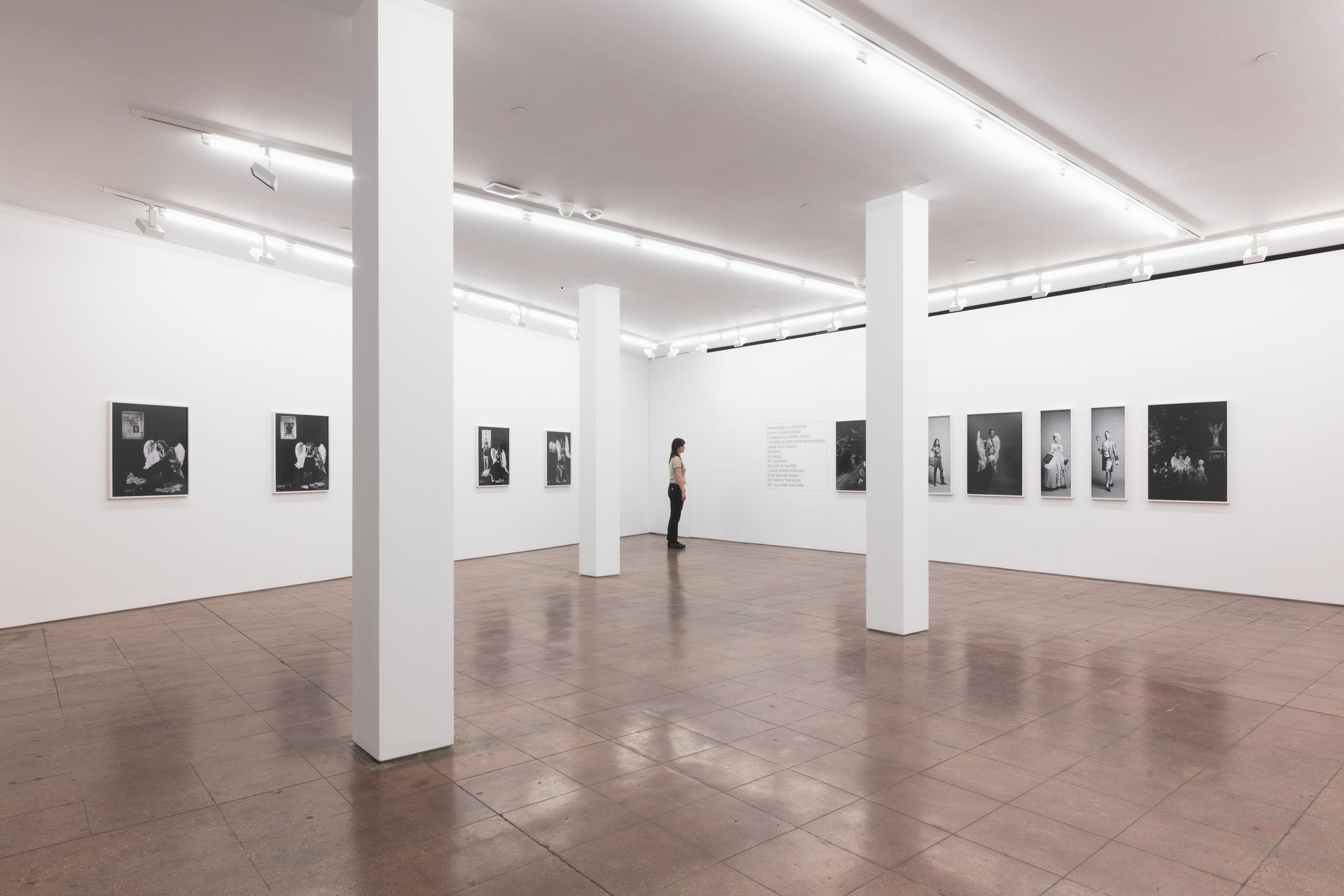
Boffin was a pioneering artist and a key organizing figure in the UK’s photography scene, working between the mid-1980s to the early 1990s. Despite a brief oeuvre, Tessa developed a complex body of photographic work which explored gender, sex positivity and societal and political issues referring to AIDS. In staged scenes, Boffin championed lesbian visibility and the actualization of queer identity through explorations of fantasy. Boffin had a bold, ground-breaking practice at a time of little visual representation and acknowledgement of queer desire. In imaginative discovery, she deconstructed historical heterosexual role models, combining fact and story to reimagine them. Deftly weaving historical references, critical theory and wit to propose an alternative space of exploration.


Reflecting on Tessa’s Journey
Tessa Boffin’s artistic journey was tragically brief but extraordinarily impactful, encompassing less than a decade of professional practice yet producing work that continues to resonate decades after her death. From her emergence in the mid-1980s through her suicide in 1993 at age 33, Boffin navigated extraordinarily difficult terrain: creating art during the AIDS crisis while addressing lesbian exclusion from public discourse, working within but also against lesbian feminist movements that sometimes viewed her sex-positive approach with suspicion, and trying to build a career as a queer artist in an art world that offered few resources or opportunities for LGBTQIA2S+ practitioners. The pressures she faced were immense, operating at the intersection of the personal (her own identity and relationships), the political (AIDS activism and LGBTQIA2S+ rights), and the professional (trying to sustain an artistic practice with limited institutional support). That she managed to create such sophisticated, beautiful, and politically urgent work under these conditions is remarkable.
The final years of Tessa’s life were particularly difficult, marked by personal struggles and community conflicts that took a serious toll. The controversy surrounding her Crucifixion Cabaret performance in 1992 demonstrated how even within queer communities, pushing boundaries and challenging orthodoxies could result in harsh criticism and social isolation. The disagreement with Del LaGrace Volcano over the use of blood in performance during the AIDS crisis revealed genuine political differences within activist communities about how to respond to the epidemic and what kinds of artistic representation were appropriate or responsible. These weren’t abstract debates but deeply felt conflicts that affected personal relationships and community cohesion. Beyond these public controversies, Boffin was also struggling with questions about her gender identity, trying to find support and language for experiences that challenged the categories available to her. She encountered difficulty finding community understanding or professional resources for these struggles. Additionally, Boffin and her girlfriend Nerina Ferguson were physically attacked in a queer club for dressing in drag, a violent reminder that even supposedly safe spaces weren’t always welcoming to gender non-conforming people.
Reflecting on Boffin’s journey also means grappling with the devastating loss of potential that her early death represents. At 33, she was just beginning to establish herself professionally, with major exhibitions and publications to her credit and a distinctive artistic voice that was gaining recognition. What might she have created had she lived? How might her work have evolved? Would she have found the community support and recognition that seemed so elusive in her final years? These questions are impossible to answer but important to ask, as they remind us of the human cost of homophobia, transphobia, and the social conditions that make life unbearable for some queer people. In her obituary, Simon Watney wrote perceptively about how Boffin’s work involved “a dark vision of the world, in which we have to struggle to make sense of ourselves and our often conflicting, painful desires.” This darkness wasn’t just aesthetic but reflected real struggles and real pain. At the same time, Tessa’s work also contains joy, humor, beauty, and hope. Her photographs imagine worlds where lesbian desire is celebrated, where queer women can claim space within cultural traditions, where safer sex can be erotic and pleasurable. This dual quality, acknowledging darkness while creating beauty and possibility, defines Boffin’s legacy and makes her work feel urgent and relevant even decades after her death.