Pride Palette

Pride Palette

033. Julio Salgado

Undocu-Queer and Unapologetic: The Visual Legacy of Julio Salgado
Profoundly Parker (They/Them) and E. H. Bloomfield
Feb 07, 2026
∙ Paid
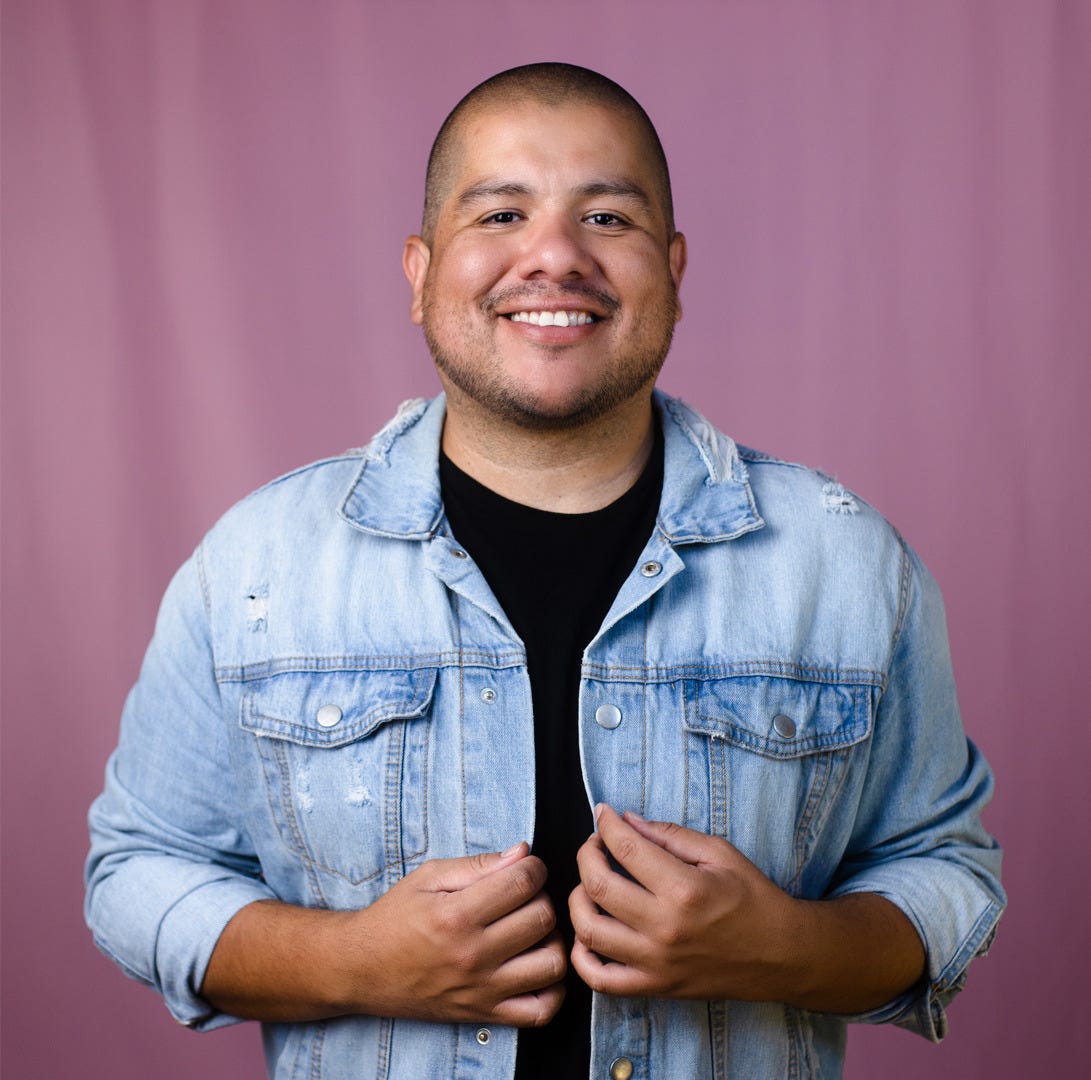
In this photo, Julio is a smiling Hispanic man standing against a light pink background, wearing a light blue denim jacket over a black t-shirt. His hands grasp the jacket sides, conveying a friendly and approachable demeanor. He is smiling straight into the camera, he has mustache and beard stubble, and a shaved head.
Image courtesy of Portland Institute for Contemporary Art.

Introduction

Julio Salgado is a Mexican-born, queer, undocumented visual artist whose work exists at the intersection of art, activism, and lived experience. Best known for his bold digital illustrations, posters, and comics, Salgado has become a defining voice in contemporary undocumented and LGBTQIA2S+ visual culture. His art does not merely represent marginalized communities; it emerges from within them, shaped directly by his experiences navigating immigration precarity, queer identity, and systemic exclusion in the United States. Across his body of work, Salgado insists on visibility, humanity, and joy in spaces that often reduce undocumented people to statistics or threats.

Born in Ensenada, Baja California, Mexico, Salgado immigrated to the United States as a child due to a family medical emergency. His younger sister required life-saving treatment unavailable to her in Mexico, a decision that ultimately saved her life but placed the family in a state of long-term undocumented status. This origin story, rooted in survival rather than choice, becomes a foundational theme in Salgado’s work, challenging dominant narratives that criminalize undocumented migration while ignoring its human causes. His art consistently reframes migration as an act of care, love, and necessity rather than illegality.

1) Illustration of five diverse individuals standing together, displaying unity. Text reads, "Despite the pain, tears, criminalization, erasure, and heartache, WE EXIST!" This piece emphasizes resilience and solidarity. There is a small red wall/border on the bottom, and each person has one leg in front of it. The wall reads: 'Bigger than any border'. The person in the front and center is black with blue hair, a yellow shirt that reads 'We Exist' in black text, and they are wearing red pants with purple boots. On the far left, there is a black person wearing a yellow shirt and green pants, white shoes, holding a cane. Next to them, there is a black muslim person wearing an aqua hijab, green shirt, blue pants, and white shoes. The fourth person from the left is a black person wearing a white shirt, blue pants, white socks, and black shoes. The last person on the right is a Hispanic person wearing a purple tank top, black shorts, and pink boots. Julio's signature and the year is written in a lavender outline around the people, above the last person's shoulder. The overall background color is purple, while the text at the top is in black, and We Exist! is in lavender as well. There is green grass on the bottom of the piece in front of the wall. 2) Illustration of a blue-faced person with rainbow hair adorned with protest signs. Themes include social justice, equality, and empowerment, set against a pink-orange gradient background. The person has a yellow necklace, and pink flowers along their hairline. The signs use these messages: Disability Justice, This is Native Land, Thank Black and Brown Trans Women for Pride, Queer Art, Fight for Trans Lives, No Muslim Ban, Queer as Fuck, Be Inclusive as Fuck!, Black Lives Matter, Fuck Your Borders, No Pink Washing, #METOO, Fuck White Supremacy, Make Love Not War.1) Illustration of five diverse individuals standing together, displaying unity. Text reads, "Despite the pain, tears, criminalization, erasure, and heartache, WE EXIST!" This piece emphasizes resilience and solidarity. There is a small red wall/border on the bottom, and each person has one leg in front of it. The wall reads: 'Bigger than any border'. The person in the front and center is black with blue hair, a yellow shirt that reads 'We Exist' in black text, and they are wearing red pants with purple boots. On the far left, there is a black person wearing a yellow shirt and green pants, white shoes, holding a cane. Next to them, there is a black muslim person wearing an aqua hijab, green shirt, blue pants, and white shoes. The fourth person from the left is a black person wearing a white shirt, blue pants, white socks, and black shoes. The last person on the right is a Hispanic person wearing a purple tank top, black shorts, and pink boots. Julio's signature and the year is written in a lavender outline around the people, above the last person's shoulder. The overall background color is purple, while the text at the top is in black, and We Exist! is in lavender as well. There is green grass on the bottom of the piece in front of the wall. 2) Illustration of a blue-faced person with rainbow hair adorned with protest signs. Themes include social justice, equality, and empowerment, set against a pink-orange gradient background. The person has a yellow necklace, and pink flowers along their hairline. The signs use these messages: Disability Justice, This is Native Land, Thank Black and Brown Trans Women for Pride, Queer Art, Fight for Trans Lives, No Muslim Ban, Queer as Fuck, Be Inclusive as Fuck!, Black Lives Matter, Fuck Your Borders, No Pink Washing, #METOO, Fuck White Supremacy, Make Love Not War.
1-2) Images courtesy of the artist's website.

Julio describes his practice as “artivism,” a deliberate blending of art and activism that prioritizes political impact over institutional approval. His work has been used in protests, circulated widely online, and featured in museums, universities, and activist campaigns. Whether addressing anti-immigrant legislation, ICE raids, or queer visibility, Salgado’s images function as tools for collective empowerment. They invite viewers not only to witness injustice, but to recognize undocumented queer people as symbols of resistance.

At its core, Salgado’s work insists on complexity. He refuses narratives that portray undocumented people solely as victims, instead emphasizing resilience, intimacy, humor, desire, and community. By centering Undocu-Queer lives, his art disrupts both immigration discourse and mainstream LGBTQIA2S+ representation, carving out space for identities that are too often excluded from both conversations. In doing so, Julio Salgado has helped reshape how undocumented activism is visualized, remembered, and felt.

1) Cartoon showing two ICE agents in blue shirts confronting a brown woman in a yellow shirt with "I ❤️ LB" on it. Text: "If ICE approaches you on the street, you have the right to remain silent!" Tone: Informative, empowering. The woman is standing near a bus stop, and she is wearing pink pants, and has shoulder-length brown wavy hair. The sky is blue with one white cloud, and there are green and blue mountains in the back. Julio's signature and year are on the bottom, next to the woman's left leg. 2) Illustration of an ICE officer arresting a person with a bystander taking notes. Text reads: "If you see an ICE arrest in public, film or write down everything you witness." The ICE officer is wearing a blue shirt, grey pants, and black shoes. The person being arrested is a woman with her long way brown hair in a ponytail. She is wearing a blue hoodie with pink capris, and black and white sneakers. The person taking notes has long brown wavy hair, and she is wearing a teal shirt, with purple pants. The sky is orange, with a big yellow sun, and some white clouds. They are all standing on green grass. There is a logo for Orale in the bottom right corner, and Julio's signature and year is in the bottom left corner. 3) Illustration of a man in an ICE shirt holding a paper at a closed door. Text advises asking for a warrant without opening the door. Emphasizes caution. Text reads: 'If ICE shows up at your door: always ask to see a valid warrant without opening your door.". The ICE officer is wearing a blue shirt and grey pants, and the person inside has shoulder-length red/brown curly hair, and is wearing a purple shirt. The door is yellow, the background color is tan, and the Orale logo is in the bottom left corner. 4) Illustration of a hand slipping a red card under a yellow door, with text advising on rights if ICE visits. Emblem of a raised fist and flowers labeled "Órale" in the top right corner. Text reads: 'If ICE shows up at your home, slip your know your rights red card under the door." Julio's signature and year is in the bottom right corner. The door and wall are yellow, the floor is tan/green, and the brown person sliding the card is wearing a long-sleeve blue shirt.1) Cartoon showing two ICE agents in blue shirts confronting a brown woman in a yellow shirt with "I ❤️ LB" on it. Text: "If ICE approaches you on the street, you have the right to remain silent!" Tone: Informative, empowering. The woman is standing near a bus stop, and she is wearing pink pants, and has shoulder-length brown wavy hair. The sky is blue with one white cloud, and there are green and blue mountains in the back. Julio's signature and year are on the bottom, next to the woman's left leg. 2) Illustration of an ICE officer arresting a person with a bystander taking notes. Text reads: "If you see an ICE arrest in public, film or write down everything you witness." The ICE officer is wearing a blue shirt, grey pants, and black shoes. The person being arrested is a woman with her long way brown hair in a ponytail. She is wearing a blue hoodie with pink capris, and black and white sneakers. The person taking notes has long brown wavy hair, and she is wearing a teal shirt, with purple pants. The sky is orange, with a big yellow sun, and some white clouds. They are all standing on green grass. There is a logo for Orale in the bottom right corner, and Julio's signature and year is in the bottom left corner. 3) Illustration of a man in an ICE shirt holding a paper at a closed door. Text advises asking for a warrant without opening the door. Emphasizes caution. Text reads: 'If ICE shows up at your door: always ask to see a valid warrant without opening your door.". The ICE officer is wearing a blue shirt and grey pants, and the person inside has shoulder-length red/brown curly hair, and is wearing a purple shirt. The door is yellow, the background color is tan, and the Orale logo is in the bottom left corner. 4) Illustration of a hand slipping a red card under a yellow door, with text advising on rights if ICE visits. Emblem of a raised fist and flowers labeled "Órale" in the top right corner. Text reads: 'If ICE shows up at your home, slip your know your rights red card under the door." Julio's signature and year is in the bottom right corner. The door and wall are yellow, the floor is tan/green, and the brown person sliding the card is wearing a long-sleeve blue shirt.
1-4) Images courtesy of the artist's Instagram.

Early Life and Background

Cultural and Personal Influences

Julio Salgado’s early life was shaped by migration, medical urgency, and cultural transition. Born in Ensenada, Mexico in 1983, he spent his early childhood immersed in Mexican culture, language, and family traditions. When his family moved to the United States in the mid-1990s so his sister could receive dialysis and a kidney transplant, the shift was abrupt and transformative. While the move saved his sister’s life, it also introduced a new reality defined by undocumented status, instability, and fear, conditions that would later become central to Julio’s art.
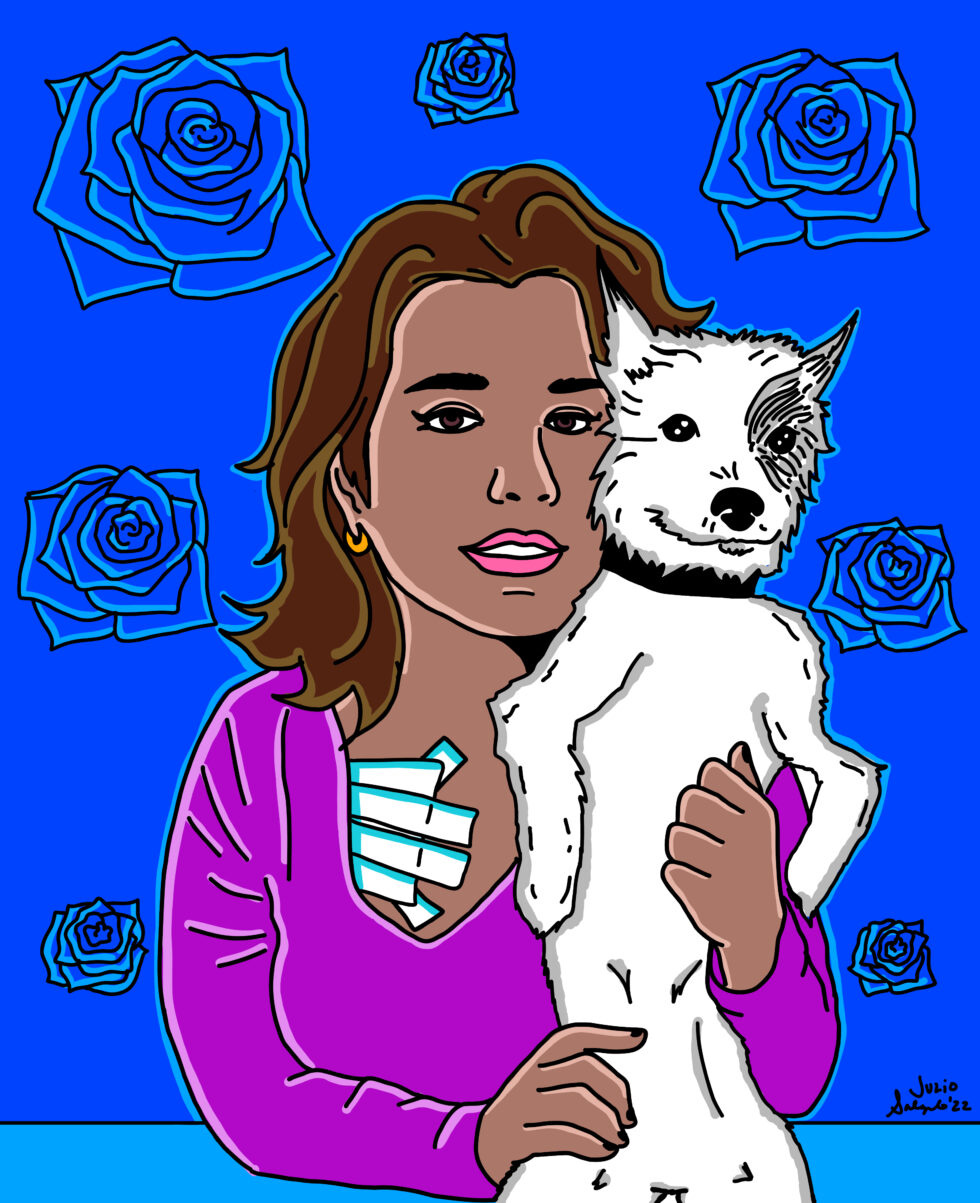
Illustration of a brown woman in a purple top holding a small white dog with a black eye patch. Blue background with stylized blue roses. The woman has shoulder-length brown hair, she's wearing small gold hoop earrings, and pink lipstick. She has white bandages on her chest, possibly from a recent surgery, or from having a port for cancer treatment.
Image courtesy of the artist’s Illegal Blog.

Growing up undocumented in Long Beach, California, Salgado learned early how immigration status quietly governs everyday life. As a child, he did not fully understand the implications of being undocumented, but as he grew older, those limitations became more visible, particularly around employment, travel, and higher education. This gradual realization shaped his sense of self and belonging, creating an awareness of invisibility within systems that nevertheless exerted constant control. These experiences fostered an early political consciousness, even before he had language for activism.

Culturally, Salgado navigated the expectations of a Mexican household alongside the pressures of assimilation in the U.S. His upbringing exposed him to traditional gender roles and machismo, which later complicated his process of coming out as queer. While his undocumented identity was something he could share more easily with peers who shared similar circumstances, his queer identity required deeper personal negotiation. This layered experience of disclosure, what could be spoken and what had to remain hidden, profoundly influenced how Julio understands visibility and silence.

1) Illustration of a brown person with closed eyes, drawing on their chest, which reads "Drawing my brown in a sea of white." A group of white people stands behind them. The person is holding a pencil, drawing the outline of their stomach. They have short black hair, and beard stubble. The background is a brown and white gradient. 2) A colorful illustration shows a person with blue and purple skin against a green background. Surrounding them are bold words describing various actions and emotions, conveying a message of resilience and identity. On the person's chest reads: 'Illegal Faggot". The text all around them contains: I create, I mess up, I read, I fall, I get up, I cry, I laugh, I eat, I go numb, I fuck, I see, I love, I fly, I get tired, I continue.1) Illustration of a brown person with closed eyes, drawing on their chest, which reads "Drawing my brown in a sea of white." A group of white people stands behind them. The person is holding a pencil, drawing the outline of their stomach. They have short black hair, and beard stubble. The background is a brown and white gradient. 2) A colorful illustration shows a person with blue and purple skin against a green background. Surrounding them are bold words describing various actions and emotions, conveying a message of resilience and identity. On the person's chest reads: 'Illegal Faggot". The text all around them contains: I create, I mess up, I read, I fall, I get up, I cry, I laugh, I eat, I go numb, I fuck, I see, I love, I fly, I get tired, I continue.
1-2) Images courtesy of the artist's website.

These intersecting pressures instilled in Salgado a sensitivity to marginalization and resilience that continues to inform his work. Rather than separating personal experience from political critique, he treats them as inseparable. His art reflects the reality that undocumented and queer identities are not abstract categories, but lived conditions shaped by family, culture, fear, love, and survival. These early influences laid the emotional and ideological foundation for a practice rooted in empathy and resistance.

Early Exposure to Art and Education

Art became a crucial outlet for Julio Salgado at an early age, serving both as a coping mechanism and a bridge to connection. As a child, he drew constantly, using art as a way to process his environment and communicate across cultural and linguistic barriers. After migrating to the United States, drawing helped him make friends and navigate unfamiliar spaces where he often felt out of place. One of his earliest affirmations came from winning a simple drawing contest, a moment he later recalled as evidence that art could connect him to others in meaningful ways.
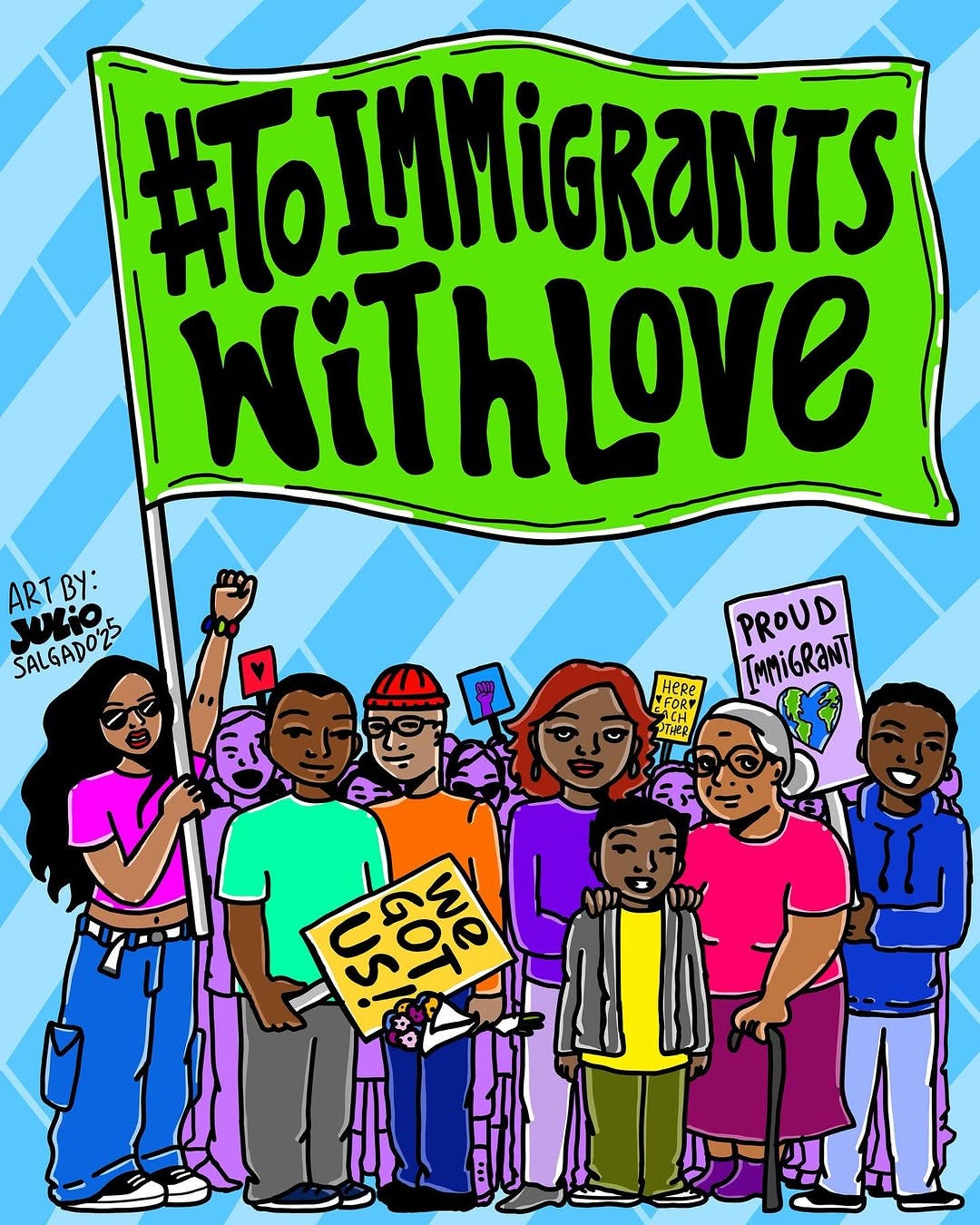
A diverse group of people stand together, holding a green banner reading "#ToImmigrantsWithLove." They carry signs supporting immigrants, conveying unity and compassion. The background is a patterned blue and light blue, and the crowd is full of black and brown people. Some of the signs read: "We got us!", and "Proud Immigrant" with a heart-shaped Earth below. Julio's signature and the year is on the center left side, above someone's hair.
Image courtesy of the artist’s Instagram.

Throughout his schooling, Salgado continued to develop his artistic skills alongside a growing interest in storytelling. In high school and college, he became involved with student newspapers, where he contributed illustrations and editorial cartoons. These early works marked the beginning of his fusion of art and political commentary, as he used humor and visual metaphor to critique social issues affecting his community. This period was especially formative in shaping his understanding of art as a communicative tool rather than a purely aesthetic pursuit.

“I have been drawing since I was a little kid. But it wasn’t until I joined the school newspaper that my political opinions began to develop in a more tangible way. I could draw and make my opinions heard. When I transferred to Long Beach City College as a journalism major, I used the student newspaper to voice my opinions, especially as an undocumented student of color. I was highly outspoken but in a careful way. It was still the early 2000s. and not everyone was out as undocumented in that way.”

— Julio Salgado in an interview with Clarissa Jasso of The Latinx Project
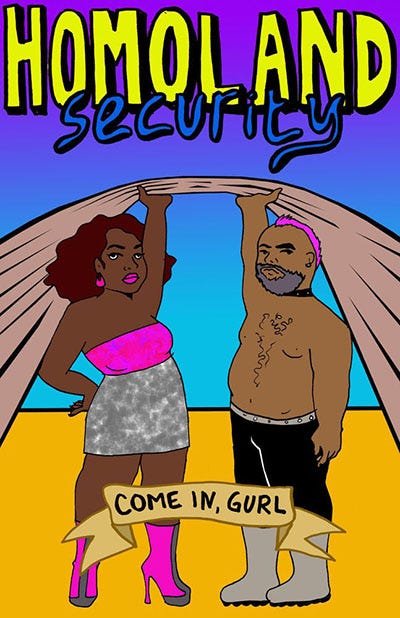
Illustrated poster with two confident figures holding up a fabric backdrop. The colorful text reads "Homoland Security." Banner below says “Come in, gurl.” Bright and bold tone. Homoland is in yellow, and security is in blue. The bottom banner is tan with black text. The background color is a purple and blue gradient, with an orange bottom. The person on the left is a black person wearing a pink top, and silver skirt, with pink high heel boots. They have shoulder-length curly brown hair, pink hoop earrings, and pink lipstick. On the right, a brown person who is shirtless is wearing black pants, grey boots, and they have a grey beard, and a small pink mohawk.
Image courtesy of the artist’s website.

Julio studied journalism at California State University, Long Beach, an educational path that deeply influenced his artistic methodology. Journalism taught him how to distill complex issues into accessible narratives, a skill that translated seamlessly into visual form. His background in reporting sharpened his attention to accuracy, context, and audience, qualities that distinguish his activist artwork from purely symbolic protest imagery. Even as he moved away from traditional journalism, its principles remained embedded in his approach.

Educational spaces also introduced Salgado to undocumented student organizing and grassroots activism, which helped politicize his identity more explicitly. Collaborating with other undocumented students allowed him to see how shared experiences could become collective power. Art became his contribution to that movement: a way to document, amplify, and humanize undocumented struggles. From this point forward, Salgado’s artistic path was inseparable from his commitment to social justice.

Artistic Influences and Style

Key Influences

Julio Salgado’s artistic influences are rooted in political necessity as much as cultural inheritance. He draws heavily from Chicano and Latinx art traditions that have historically used visual language to resist oppression, document struggle, and affirm collective identity. These traditions taught Salgado that art could operate as a form of survival, a way to preserve memory and assert presence in systems designed to erase marginalized communities. Murals, protest posters, and movement graphics provided early examples of how images could mobilize people and communicate urgency without relying on institutional permission.

1) Colorful illustration of diverse individuals with vibrant hair, alongside empowering texts like "Dear Immigrant, allow yourself to be complex" in bold fonts. The text also includes: 'Get mad, fall down, cry, be weak, be vulnerable". The person in the front and center is brown, has short pink hair, red lipstick, and they are wearing a grey shirt with red sleeves, and a black x on the chest. To the left of them, there is a shirtless brown person with tattoos, wearing blue pants, and with a black beard. 3rd person from the left is a brown person with short purple hair, is wearing a choker and a white tank top. The last person on the right is a black person wearing purple eye makeup and mascara, with purple lipstick. They have aqua shoulder-length hair, and are wearing a semi-see-through black top. The overall background is white, with a yellow outline around everyone. Julio's signature and year are in the bottom right corner, in the right bend of the X in complex. 2) Illustration of six diverse, serious-faced individuals holding signs reading "Know Your Rights!" and "All Hands on Deck!" with text "Not Going Back into the Shadows." This features black, brown, and Asian people. Julio's signature and year are in the center right, above someone's shoulder.1) Colorful illustration of diverse individuals with vibrant hair, alongside empowering texts like "Dear Immigrant, allow yourself to be complex" in bold fonts. The text also includes: 'Get mad, fall down, cry, be weak, be vulnerable". The person in the front and center is brown, has short pink hair, red lipstick, and they are wearing a grey shirt with red sleeves, and a black x on the chest. To the left of them, there is a shirtless brown person with tattoos, wearing blue pants, and with a black beard. 3rd person from the left is a brown person with short purple hair, is wearing a choker and a white tank top. The last person on the right is a black person wearing purple eye makeup and mascara, with purple lipstick. They have aqua shoulder-length hair, and are wearing a semi-see-through black top. The overall background is white, with a yellow outline around everyone. Julio's signature and year are in the bottom right corner, in the right bend of the X in complex. 2) Illustration of six diverse, serious-faced individuals holding signs reading "Know Your Rights!" and "All Hands on Deck!" with text "Not Going Back into the Shadows." This features black, brown, and Asian people. Julio's signature and year are in the center right, above someone's shoulder.
1-2) Images courtesy of the artist's Instagram.

Equally influential is the visual language of grassroots activism, particularly protest signs, zines, and digital graphics. Salgado’s work mirrors the immediacy and accessibility of these formats, emphasizing bold lines, vibrant color palettes, and emotionally legible figures. His art is intentionally designed to circulate, shared on social media, reproduced at marches, and used by organizers, rejecting the idea that meaningful art must be confined to galleries. This influence aligns with his commitment to community-based creation rather than elite artistic validation.

Comics and editorial cartoons also play a critical role in shaping Julio’s aesthetic. His background in journalism trained him to communicate layered narratives quickly and clearly, a skill reflected in his visual storytelling. Like political cartoons, his illustrations often compress complex realities, immigration policy, queer desire, fear, and joy, into singular moments that resonate immediately. This influence reinforces his belief that art should inform, provoke, and educate simultaneously.
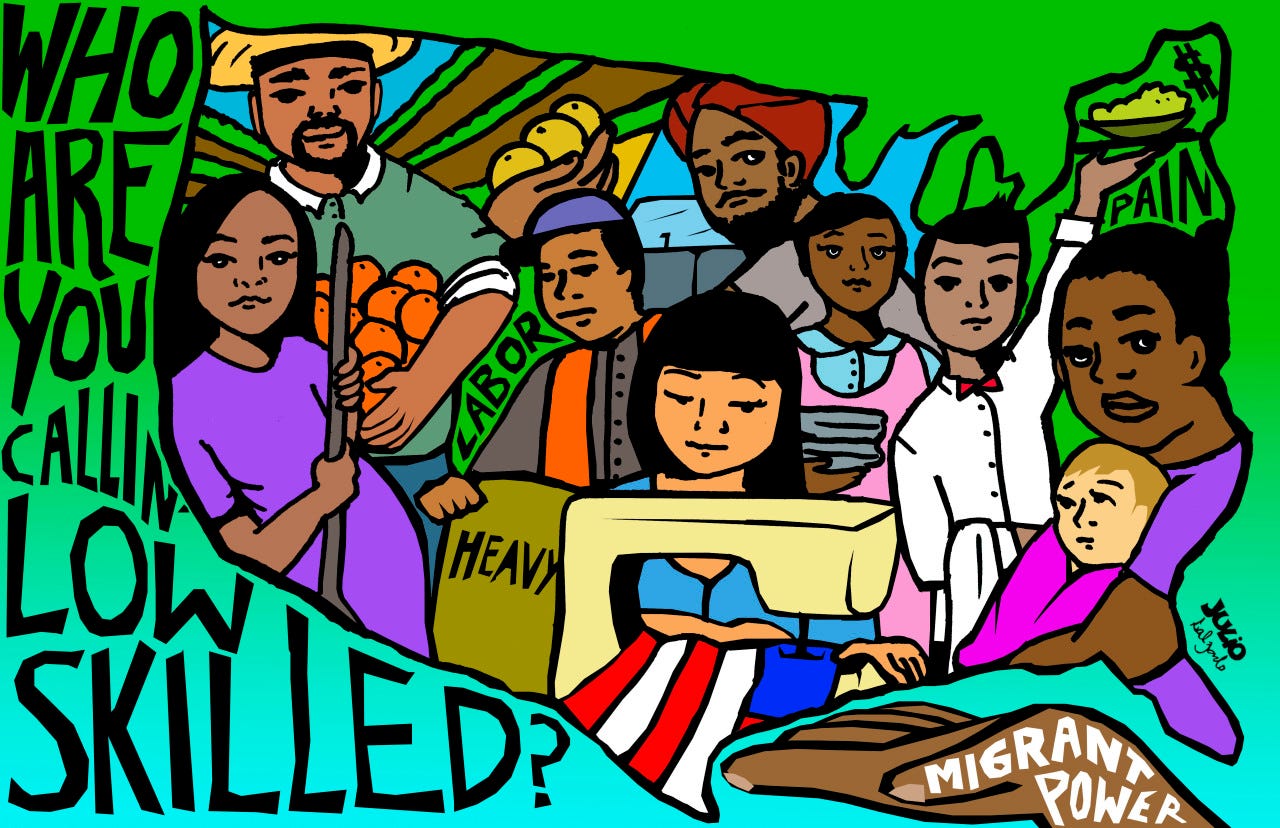
Illustration of diverse workers with tools, sewing machine, and food, challenging "low-skilled" label. Bold text reads "Who are you callin' low skilled?" and “Migrant Power” is on a brown hand in the bottom right corner. The workers are all in a shape of the United States. Julio's signature is in the bottom right, near the bottom of Florida. The image is filled with people from pregnant women/moms, to men working in the fields, or serving food. There are some words within the piece like, Pain, Labor, Heavy, and a dollar sign. The overall background is a green and aqua gradient.
Image courtesy of Los Angeles Blade.

Salgado is also deeply influenced by queer visual culture, particularly work that centers intimacy, softness, and pleasure alongside resistance. His figures often embrace, rest, or exist tenderly together, countering dominant depictions of undocumented people as perpetually suffering or hyper-visible only through trauma. These influences allow Salgado to expand the emotional range of activist art, insisting that joy itself is a radical and political act for undocumented queer communities.

Art + Identity

Identity is not merely a subject in Julio Salgado’s work, it is its foundation. As an undocumented queer person, Salgado understands identity as something constantly negotiated under surveillance and constraint. His art reflects this lived reality, portraying figures who exist in between legal categories, cultural expectations, and gender norms. Rather than simplifying these identities, Julio embraces their complexity, presenting Undocu-Queer life as layered, fluid, and deeply human.

Salgado’s work challenges the idea that undocumented identity must be hidden or sanitized to be palatable. Instead, he centers brown, queer bodies unapologetically, often placing them at the center of the composition with confidence and tenderness. These images confront both mainstream immigration narratives that criminalize undocumented people and LGBTQIA2S+ spaces that often marginalize immigrants of color. By doing so, Salgado asserts that undocumented queer people are not exceptions within either community, they are integral.
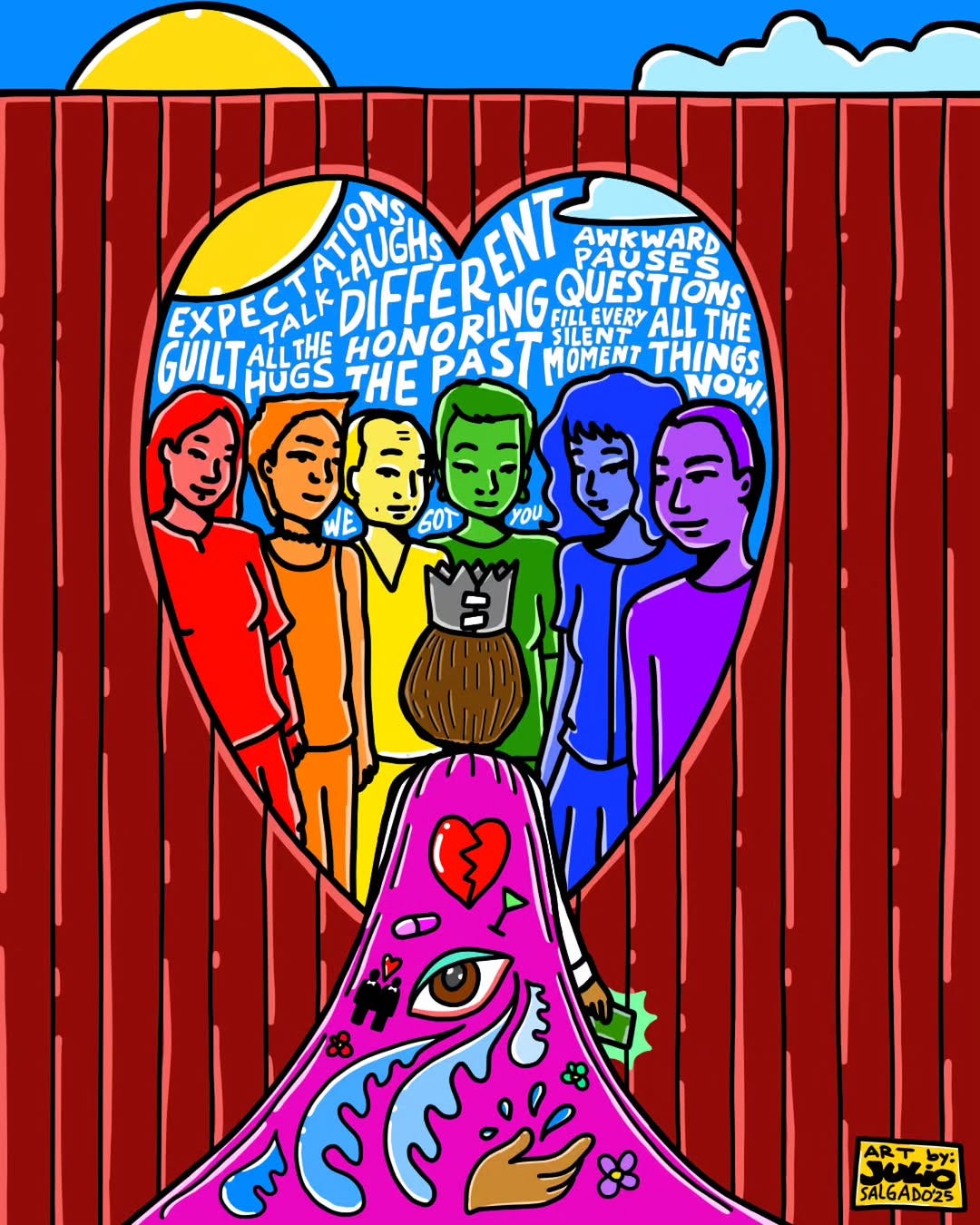
A heart-shaped cutout in a red fence reveals colorful figures and supportive words in white inside. Below, a child is standing there, wearing a pink cape that has an eye overflowing with tears amid various symbols, like pills, alcohol, a hand, flowers, and more. The people standing on the other side of the fence all represent a color of the rainbow. The child is holding a green card. Julio's signature and year are in the bottom right corner, in a yellow box. There is a blue sky with a cloud and yellow sun at the top. Some of the words written inside of the heart are "Expectations, guilt, talk, laughs, all the hugs, different, honoring the past, awkward pauses, questions, fill every silent moment, all the things now!, and we got you". The child is wearing a grey crown, and has shoulder-length brown hair.
Image courtesy of the artist’s Instagram.

“I started telling the stories of immigrants like myself and interesting people I met, but my whole idea was that immigrants do amazing things for society and this country. We need to highlight the things we bring in–not just data that says immigrants are good for the economy but actual personal stories.

I do that to this day. My goal is to continue to push out their stories, especially right now when we’re being told to be quiet and afraid. But I’ll be damned if I stop and not continue to tell the stories of my communities.”

— Julio Salgado in an interview with Clarissa Jasso of The Latinx Project

Language and self-definition are also central to Julio’s exploration of identity. His frequent use of the term “Undocu-Queer” reflects a political reclaiming of labels historically used to exclude or harm. Through art, he transforms these identifiers into sources of pride and solidarity. His work insists that naming oneself is an act of resistance, particularly in systems that rely on categorization and documentation to control bodies.

Importantly, Salgado’s representations resist respectability politics. His figures are not depicted as model minorities or idealized citizens-in-waiting. Instead, they are lovers, friends, organizers, and dreamers, people whose worth is not dependent on legality or assimilation. This approach reframes identity as intrinsic rather than conditional, challenging viewers to reconsider who is allowed to belong.
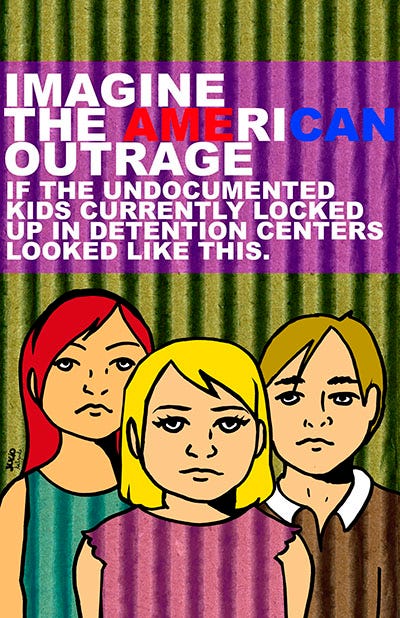
Illustration of three solemn white children with different hair colors, set against a striped background, and they all have striped tops, like bars. The text above them reads: 'Imagine the American Outrage if the undocumented kids currently locked up in detention centers looked like this.' The text is in white with a transparent purple background. The word American consists of red white and blue, with AME in red, RI in white, and CAN in blue.
Imagine the American Outrage, 2013. Image courtesy of the artist’s website.

Julio’s work also makes space for a quieter, deeply personal form of survival: sobriety. In discussing his life and identity, Salgado has spoken about being sober and how recovery has shaped the way he understands selfhood, healing, and community. This matters in the context of his art because his work is not only about resisting racist systems like ICE, but also about resisting the internalized harm that marginalized people are often forced to carry. His sobriety becomes part of his larger commitment to living fully and truthfully as an Undocu-Queer person. By creating artwork that acknowledges alcoholism and recovery, Salgado expands the conversation beyond politics alone, showing that liberation also includes the right to heal, to choose life, and to reclaim control over one’s body and future.

“The longer I go without drinking, the more I have to remind myself of the good things I’ve personally found rewarding about this process. It’s been nice spending Sundays outside of my bedroom! One must not get cocky though. As my therapist and my doctor constantly remind me, this is something one truly takes one day at a time. I’ve always used alcohol as my go-to reward for the challenges life throws my way.

But my body was like, girl, you better find a new way to reward yourself or I’m about to give up!

Sobriety is something that is working for ME and this is MY journey. But this is something I haven’t done alone. Shoutout to the folks who’ve been there from day 1 and saw the messy me that needed some time to address the issue.

If you’re struggling with substance abuse, know that you’re not alone. Fuck all that shame nonsense. Find the community that will support you in this journey. If anything, I am one DM away.

And lastly, just be kind to yourself. We’re all still trying to figure it out.”

— Julio Salgado on his Illegal Blog

1) Cartoon of a roller coaster spelling "Sober" with colorful cars and riders on a sunny day. Text reads, "Sobriety is not linear." Date: November 19, 2024. This is part of Julio Salgado's Sober Daily comic, and his signature and year are in the bottom left corner. It also says this was his 1,451 day being sober. The rollercoaster sits against a blue sky background, with green grass below, and white clouds, with a yellow sun in the sky. 2) Colorful cartoon of a wide-eyed woman with pink ear-length hair, holding a martini glass. "One more" is repeatedly written in bold around her. This cartoon has chaotic energy and is implying how crazy alcoholics can sound when requesting one more. She is wearing a black choker, a white shirt with a black bra lace coming from underneath, and she has small hoop earrings. Her teeth are also very large and comical.1) Cartoon of a roller coaster spelling "Sober" with colorful cars and riders on a sunny day. Text reads, "Sobriety is not linear." Date: November 19, 2024. This is part of Julio Salgado's Sober Daily comic, and his signature and year are in the bottom left corner. It also says this was his 1,451 day being sober. The rollercoaster sits against a blue sky background, with green grass below, and white clouds, with a yellow sun in the sky. 2) Colorful cartoon of a wide-eyed woman with pink ear-length hair, holding a martini glass. "One more" is repeatedly written in bold around her. This cartoon has chaotic energy and is implying how crazy alcoholics can sound when requesting one more. She is wearing a black choker, a white shirt with a black bra lace coming from underneath, and she has small hoop earrings. Her teeth are also very large and comical.
1-2) Images courtesy of the artist's Instagram.

Art + Activism

Activism is inseparable from Julio Salgado’s artistic practice. His work emerged directly from undocumented youth organizing, where visual storytelling played a critical role in movement-building. Early in his career, Salgado began creating artwork for immigrant rights campaigns, rallies, and online platforms, using illustration to humanize policies that often felt abstract or distant. His art became a way to translate political demands into emotional resonance.

A significant portion of Julio’s work directly confronts immigration enforcement, particularly ICE and the culture of fear it perpetuates. His illustrations often depict the emotional toll of raids, detention, and deportation, while also highlighting collective resistance. Rather than portraying ICE as an abstract institution, Salgado emphasizes its negative impact on families, relationships, and everyday life. This approach reframes enforcement as violence rather than bureaucracy.

1) A cartoon drawing shows a brown woman defiantly telling an ICE officer, "No sir, I will not show you my papers," with a determined expression. There are 2 light-skinned people standing in solidarity behind her. She is wearing a pink shirt with a pink bow in her brown shoulder-length hair. The background color is a yellow and orange gradient. 2) A purple-skinned person with blue shoulder-length hair stands amid icons of deportation protest: a broken-heart California shirt, signs reading "STOP KIDNAPPING PEOPLE," legal rights, groceries, perfume, and a police car. The background is orange with a spiral yellow pattern. The tone is urgent and advocacy-focused. Julio's signature is in the bottom-right corner.1) A cartoon drawing shows a brown woman defiantly telling an ICE officer, "No sir, I will not show you my papers," with a determined expression. There are 2 light-skinned people standing in solidarity behind her. She is wearing a pink shirt with a pink bow in her brown shoulder-length hair. The background color is a yellow and orange gradient. 2) A purple-skinned person with blue shoulder-length hair stands amid icons of deportation protest: a broken-heart California shirt, signs reading "STOP KIDNAPPING PEOPLE," legal rights, groceries, perfume, and a police car. The background is orange with a spiral yellow pattern. The tone is urgent and advocacy-focused. Julio's signature is in the bottom-right corner.
1) No Sir, I Will Not Show My Papers. Image courtesy of the artist's website. 2) Image courtesy of the artist's Instagram.

Salgado’s activism-driven art also rejects narratives of passive victimhood. Many of his pieces depict undocumented people organizing, protesting, loving, and surviving together. These images function as both documentation and motivation, affirming that resistance is ongoing and collective. By visualizing undocumented people as active agents, Julio disrupts narratives that frame them solely as recipients of charity or policy reform.

Importantly, Salgado sees art as a long-term commitment rather than a reaction to political moments. His practice is not limited to election cycles or news headlines; it exists as an ongoing archive of undocumented queer resistance. Through this sustained engagement, his work helps build cultural memory, ensuring that undocumented struggles and victories are not forgotten.
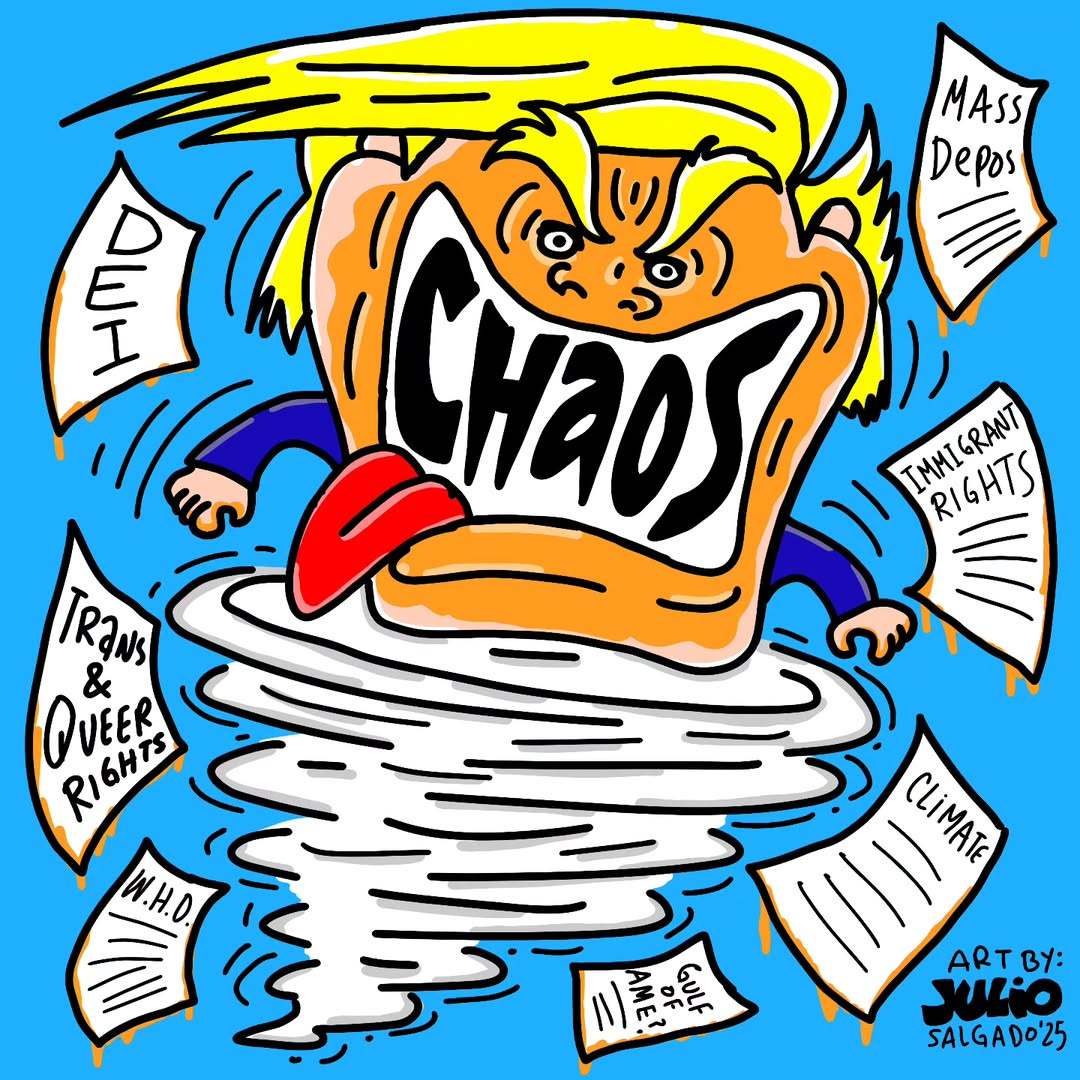
A cartoon of a whirlwind with Trump's face yelling "chaos," surrounded by swirling papers labeled DEI, Trans & Queer Rights, Immigrant Rights, W.H.O., Gulf of Ame?, Mass Depos, and Climate. Bright, chaotic scene. The background is blue, and there is a yellow liquid leaking off of each paper. Julio's signature and year are in the bottom right corner in black.
Image courtesy of the artist’s Instagram.

“I try to balance both my mental health and being an activist. There’s the reactive art I do when I hear something in the news and I’m like, “Oh brother, this would be funny to make a cartoon about.”Then, there’s the art that goes deeper into telling stories about my community. There’s a comic strip I did for the LA Times, titled Good immigrant, Bad immigrant, and it’s basically a lot about me and my life as an undocumented immigrant. I named my comic strip Good Immigrant, Bad Immigrant because of this idea that we, as immigrants, can only be those two things. When in reality, as human beings, we are many things. The difference is that immigrants are not allowed to make mistakes. If we make a mistake, that could mean deprivation to a lot of us.

It’s an honor and a privilege to be able to make sense of these things through art and have other people read the work that I do or share the artwork I make. It makes me feel like I’m not the only one thinking this. A lot of us are thinking this way, and my art is just my way of adding to that conversation.”

— Julio Salgado in an interview with Clarissa Jasso of The Latinx Project
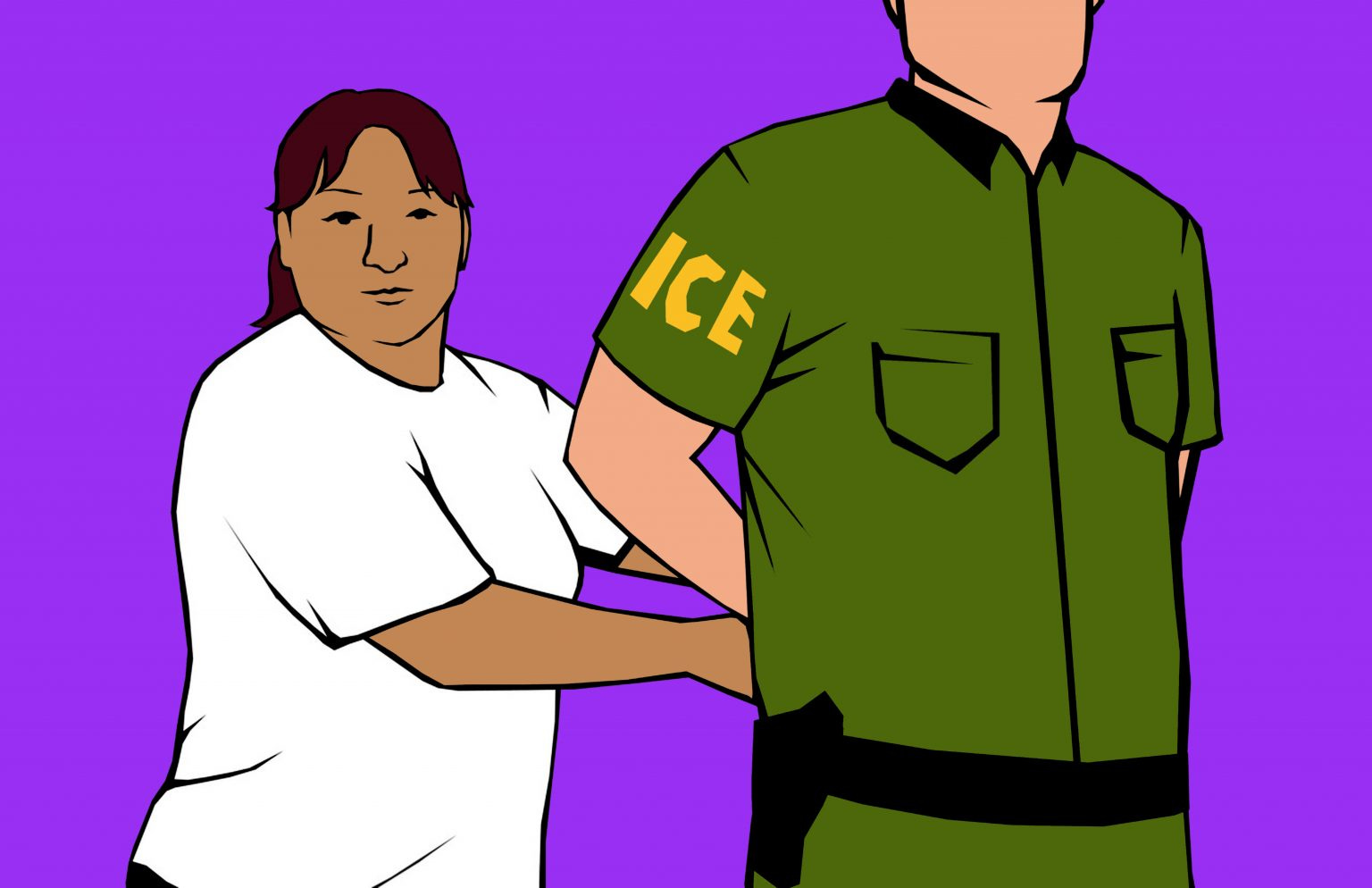
Illustration of a brown person in a white shirt handcuffing an ICE officer in a green uniform with "ICE" in yellow on the sleeve, set against a purple background. The person arresting the officer has long brown hair in a ponytail.
Image courtesy of Los Angeles Blade.

Julio Salgado’s art is an act of resistance in a moment when ICE raids, mass surveillance, and immigration enforcement are escalating into something openly authoritarian. What is happening to immigrants, and increasingly to citizens caught in the same storm, is atrocious, and pretending otherwise only serves those in power. Salgado uses his work to expose this violence, to humanize those targeted by it, and to demand that we confront the reality unfolding around us. We need reform, we need accountability, and we need people to stop looking away. Readers who want to help can take immediate action by using 5 Calls to pressure elected officials to defund and abolish ICE, and by donating to or volunteering at organizations doing frontline work such as RAICES, United We Dream, Al Otro Lado, National Immigration Law Center, and local immigrant defense funds. Let us be clear: Pride Palette does not tolerate hatred, bigotry, or dehumanization, except toward fascism, which must be named, opposed, and dismantled. We are watching the early warning signs of history repeating itself, and silence has never saved anyone. No one is illegal on stolen land, and we stand in solidarity with Julio Salgado and all immigrants resisting a system built to erase them.
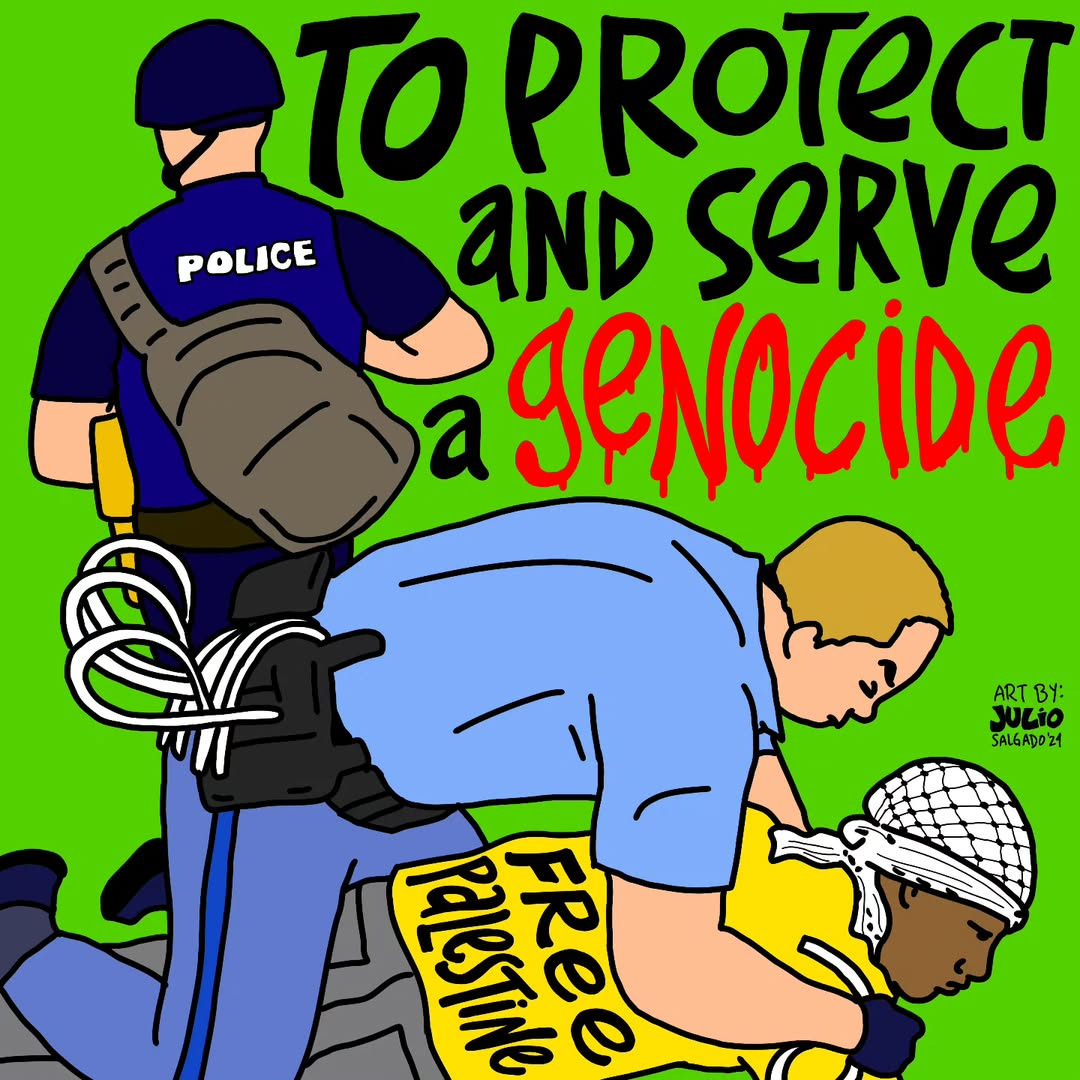
A police officer pins a protester in a keffiyeh wearing a "Free Palestine" shirt to the ground. Text above reads, "To protect and serve a genocide." The tone is critical and urgent. Another police officer is in the back, with gear on. Both cops are white, of course. The person being tackled is a black person. Genocide is written in red, with dripping blood. Julio's signature and year are on the right side, above the black person's head. The background is green.
User's avatar

Continue reading this post for free, courtesy of E. H. Bloomfield.

Or purchase a paid subscription.
© 2026 E. H. Bloomfield (he/him) · Privacy ∙ Terms ∙ Collection notice
Start your SubstackGet the app
Substack is the home for great culture